
Custom Promotional Products With Individual Names: What Changes When Every Item Is Different?

Putting the same company logo on 300 products is one type of custom-merchandise project. Putting that logo on 300 products and adding 300 different employee names is a different project entirely.
The finished products may look almost identical. Operationally, they are not.
Once every item carries a different name, initials, job title, number, location, department, or other recipient-specific information, the project introduces variable data, additional production steps, more opportunities for errors, and a much more important connection between manufacturing and fulfillment.
That does not make personalized corporate merchandise impractical. It simply means the personalization needs to be part of the sourcing plan from the beginning—not something added after the product has already been selected.
Need logo merchandise with different names, initials, titles, numbers, or locations on each piece? Send Florida Custom Merch the product idea, quantity, personalization requirements, deadline, recipient count, and delivery plan before the item is finalized. We can help determine which products and decoration methods realistically support the program. Ask Florida Custom Merch About Your Project
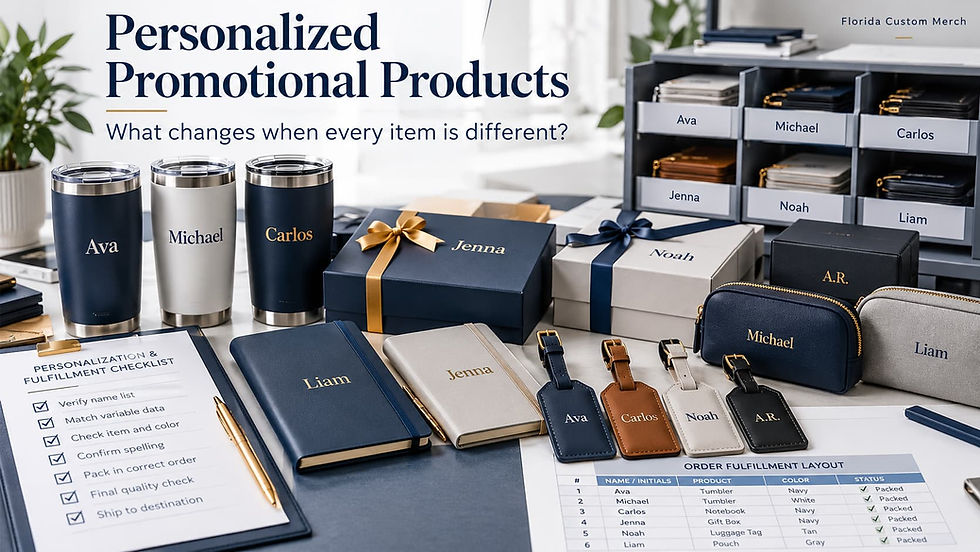
Personalization Changes the Order Before Production Even Begins
Buyers sometimes think of personalization as one extra line added beneath the logo. Visually, that may be true. From a production standpoint, however, the supplier is no longer producing hundreds of identical units from one repeated setup.
The company logo might remain constant while another part of the decoration changes on every piece. One tumbler might say Jennifer, another Michael, another Carlos, and another Alicia. An employee program might include names and departments, while a sales-award program could require individual names plus achievement levels.
That difference should be disclosed before the product is selected because not every decoration method, product surface, production process, or supplier handles variable personalization equally well. A product that is excellent for one repeated logo may become inefficient, expensive, or impractical when every unit must change.
The right starting question is therefore not simply, “Can you put names on this?” It is, “Can this specific product be efficiently produced with different personalization on every piece at our quantity and deadline?”
The Product Has to Support Both the Logo and the Individual Information
Personalized merchandise usually has two branding jobs.
The first is consistent: the company's logo, event mark, program name, or other common artwork. The second is variable: the recipient's name, initials, title, location, jersey number, award level, or another unique element.
Both need enough physical space to look intentional.
A small product may technically have room for a logo but not enough room to add a person's name without making everything feel crowded. A curved surface can limit usable decoration space. A pocket, zipper, seam, handle, or textured material may affect where variable information can be placed.
This becomes especially important when names differ dramatically in length. “Amy Li” and “Christopher Montgomery” cannot automatically be treated as the same design. The production approach needs enough flexibility for the longest realistic personalization in the data set.
That is one reason personalization should be considered during sourcing rather than after the product has already been approved.
Individual Names Turn Your Spreadsheet Into Production Artwork
With an ordinary logo order, the buyer may provide one approved artwork file.
With individually personalized merchandise, the recipient data becomes just as important as the logo.
If 250 employee names are being produced, those 250 names need to be correct before production begins. A typo in the source list can become a typo permanently decorated onto an item, even when the supplier reproduces the submitted information exactly.
That means the personalization list should be treated as production data rather than casual office information.
Use one clean, final source rather than names copied from several email threads. Decide whether employees should appear as Philippe Deray, Philippe M. Deray, PHILIPPE, or simply Philippe. Confirm accents, hyphens, capitalization, preferred names, suffixes, initials, professional titles, and unusual spellings before releasing the list.
The objective is to eliminate interpretation.
If the production team has to guess what the data means, the list is not ready.
Do Not Make the Supplier Decide How Names Should Appear
Formatting decisions are easy to overlook because they seem cosmetic.
Should everyone receive first name only? First and last name? Initials? Name plus department? Is the person's title actually part of the gift, or is that information likely to change long before the product wears out?
Those decisions affect both design and usefulness.
Adding VP SALES – SOUTHEAST REGION may make sense for equipment used specifically at work, but it may make a premium travel gift less appealing for personal use. An employee name may add meaningful ownership to a jacket or drinkware item, while printing a temporary organizational title could shorten the useful life of the product.
Personalization should make the product feel more personal, not simply put more information on it.
The strongest version usually contains information that matters to the recipient and is likely to remain relevant.
Proofing 300 Names Does Not Mean Creating 300 Casual Approval Emails
The approval process needs to be designed around the scale of the program.
For a small executive gift order, reviewing every personalized item individually may be practical. For several hundred recipients, manually emailing hundreds of separate proofs back and forth can create more opportunities for confusion than it eliminates.
Instead, determine how the personalization process for the specific product will be verified. The supplier may need an approved template showing placement, type style, relative sizing, and the relationship between the logo and variable information, along with the finalized data file that drives the unique pieces.
The important point is that the buyer needs to understand what is actually being approved.
Approving the overall layout does not magically verify that every person's name in the underlying list is spelled correctly. Conversely, approving a recipient spreadsheet does not guarantee that the decorative layout works well on the product.
Both the design and the data matter.
Our guide to changing a custom order after proof approval explains why late revisions become harder once an order has been released. With individual personalization, that principle becomes even more important because one change may affect not only artwork but also sorting and recipient assignments.
Late Adds and Employee Changes Can Become Expensive
Personalized programs often collide with a moving recipient list.
A conference gains three attendees. A new employee starts after the order has gone into production. Someone leaves the company. An executive changes titles. A trip adds another guest.
With generic merchandise, the solution might be as simple as ordering a few extra blank-identical pieces at the beginning. Personalized items are different because an extra unit does not automatically solve a missing person's need.
This is why the final recipient-list deadline should be established before production. Buyers should know when names stop being flexible and become manufacturing instructions.
For programs with predictable late additions, it may also make sense to consider whether a small quantity should remain generically branded without individual names. Those pieces can provide flexibility when the recipient list changes after personalization is locked.
That is not appropriate for every program, but it is worth considering before the list closes.
Sorting Is Part of the Production Problem
Imagine that all 400 personalized pieces are produced perfectly.
They then arrive in four cartons mixed together.
Now someone on the buyer's team has to locate Jennifer's item, Carlos's item, the item for the Miami office, twelve executive gifts, seventeen new-hire kits, and every other unique piece before distribution can begin.
The products are correct, but the project is not yet organized.
This is why personalized merchandise and fulfillment should be discussed together. Depending on the program, pieces may need to be sorted alphabetically, by department, by office, by recipient tier, by event table, by hotel guest, or according to another structure.
Packaging can help preserve that organization. A personalized product that cannot be identified without opening the package can create unnecessary work, while a clear external identifier may make distribution much faster.
The correct personalization is only useful if the correct person receives it.
Florida Custom Merch addresses the broader distribution problem in our guide to custom merchandise distribution and fulfillment. Variable personalization raises the stakes because recipient assignment is now physically attached to the merchandise.
Individual Shipping Adds Yet Another Layer
A personalized employee-gift program becomes more complex when the products are not going to one office.
If 300 individually named gifts need to be shipped to 300 residential addresses, the project contains two separate data systems: the personalization data and the shipping data.
Those systems have to remain correctly connected.
Jennifer's personalized product must end up with Jennifer's shipping label. A perfectly decorated item sent to the wrong employee is still a failed delivery.
The program may therefore involve individual packaging, address verification, shipping labels, tracking, returns, replacements, and a process for handling incomplete or incorrect addresses. Those elements affect cost and timeline independently from the decoration itself.
If direct-to-recipient shipping is required, disclose it before selecting the product. Packaging size, fragility, weight, and presentation can all affect the economics of individual fulfillment.
Personalization Can Make a Gift Feel More Valuable Without Choosing a More Expensive Product
One of the attractions of personalization is that perceived thoughtfulness does not come entirely from the base product.
Two recipients can receive the same high-quality item, but the version bearing their own name or initials may feel much more deliberately chosen.
That can make personalization particularly effective for employee recognition, leadership gifts, sales awards, incentive programs, milestone gifts, executive retreats, franchise conferences, client programs, and smaller high-value event audiences.
It can also be overused.
Individually naming thousands of low-cost public giveaways may introduce complexity without creating enough additional recipient value to justify it. The value of personalization rises when the organization actually knows who the recipient is and wants the gift to communicate individual recognition.
That distinction matters.
Personalization works best when the recipient is a person, not simply a unit in a quantity.
Different Recipient Groups May Need Different Personalization Rules
Large organizations often discover that one personalization system does not fit every recipient.
Employees may receive first names. Executives may receive initials. Franchise owners might receive location names. Award recipients may need both a name and achievement designation. Event speakers might require individual identification while general attendees receive logo-only merchandise.
That does not automatically mean four entirely separate products are needed.
A well-structured program can sometimes use one core item while varying the personalization rules by group. But those groups need to be identified before production so the supplier knows how many versions exist and how each should be handled.
This is another reason to provide context instead of simply emailing a spreadsheet with names.
Explain what the groups represent and how the final merchandise will be distributed. A supplier who understands the operating purpose has a much better chance of catching problems before they become physical products.
Rush Personalization Requires More Discipline, Not Less
A short deadline does not eliminate the data work.
It makes clean data more important.
On an ordinary logo order, a rush schedule may already compress product selection, artwork, proof approval, production, and shipping. Variable personalization adds recipient-data preparation, formatting decisions, and potentially additional production handling.
That means there is very little room for an internal list to remain “almost final.”
If you need personalized merchandise quickly, send the supplier the true deadline, quantity, product requirements, number of personalized versions, finalized recipient information, shipping model, and artwork status immediately. A product that can be decorated rapidly with one repeated logo may not have the same timeline when every piece changes.
Our guide to what to send when you need a merchandise quote fast is particularly relevant here. The supplier needs the complicated parts of the project early enough to source around them.
What Should You Send When Requesting a Quote?
Do not begin with, “How much to personalize 250 gifts?”
Start with the complete structure.
Provide the approximate quantity, desired product or product category, budget, required delivery date, common company artwork, type of personalization, number of unique recipients, and delivery plan. Explain whether each recipient needs only a name, initials, a number, title, department, office, or some combination.
Also state whether everything is shipping to one destination or whether individual fulfillment is required.
If your recipient list is not final yet, say so. The supplier can then distinguish between what can be quoted now and what must be finalized before production.
And if you already have a particular product in mind, send the link or photograph. The important question is not just whether the item can carry your logo—it is whether that exact product can support the entire personalization program realistically.
Need individually personalized branded merchandise? Send Florida Custom Merch the product idea, quantity, personalization format, number of recipients, deadline, artwork, and distribution plan. We can help determine which products and production paths fit the program before you commit to something that becomes difficult to personalize at scale. Ask an Expert
Personalization Is Really a Data-and-Fulfillment Project
The visible difference between two personalized gifts might be a single name.
Behind that name sits the recipient list, formatting rules, production method, proofing process, sorting structure, packaging plan, delivery data, and final handoff.
That is why individually personalized merchandise should be designed as a system rather than treated as an ordinary logo order with one extra field.
Done well, the complexity disappears for the recipient.
They simply receive something carrying the company's brand and their own name—and it feels as though it was made specifically for them.
That is exactly what good personalization is supposed to accomplish.
Get Noticed. Be Remembered.

