
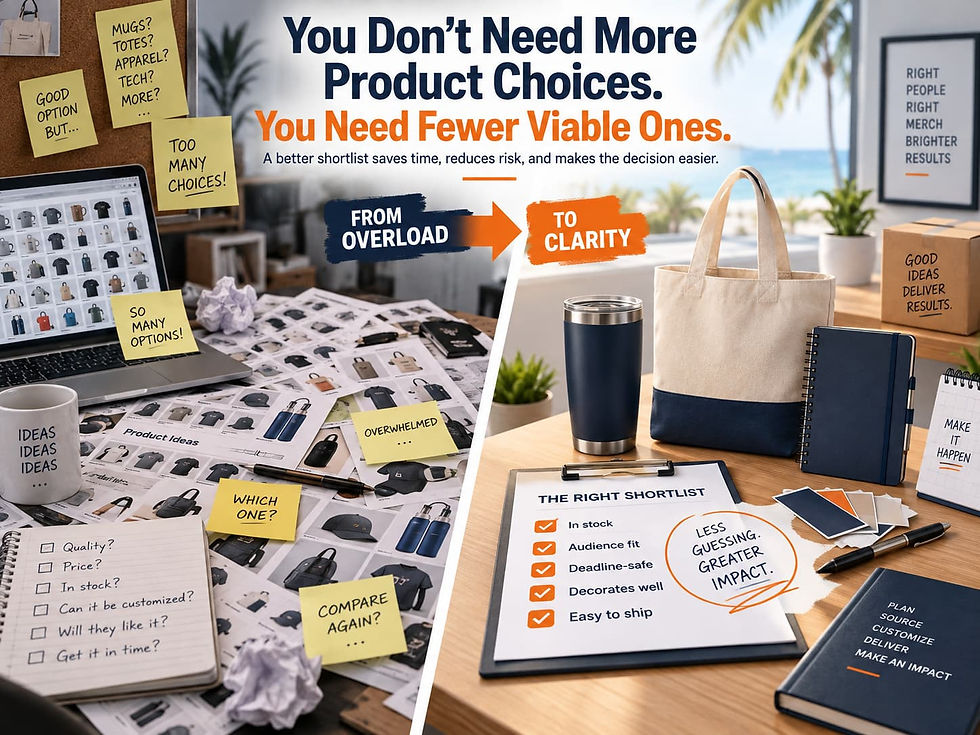
You Don’t Need More Product Choices. You Need Fewer Viable Ones.

One of the easiest ways to make a branded-merchandise project harder is to start with too many options. A buyer asks for ideas and receives 40 links, then 80, then a PDF with hundreds of products that technically fit the category, quantity, or price range.
At first, that can feel helpful because there is so much to choose from. In reality, the buyer has just been handed a much larger decision-making job.
Now someone has to figure out which products are actually in stock, which ones fit the audience, which can be produced by the deadline, which are available in the right color, which have a decoration method that will make the logo look good, and which are practical to ship, distribute, store, or reorder.
At that point, a large selection is no longer helping.
The buyer does not need more products. The buyer needs fewer viable products.
Need ideas but do not want to spend hours sorting through catalogs? Tell us the audience, quantity, budget, deadline, destination, and what you want the branded merchandise to accomplish. We can narrow the search to realistic options instead of sending you everything that technically exists. Get a Quote or Request Information →
A Catalog Is a Database, Not a Recommendation
There is nothing wrong with catalogs. They are useful tools, especially when a buyer already knows what category or product type they want.
The problem is that a catalog cannot understand the project.
It cannot know that your event is in twelve days, that your audience is mostly senior executives, that everything has to fit inside a carry-on, or that your new sponsor only approved the artwork yesterday. A catalog can show what exists, but it cannot automatically tell you what makes sense.
That is why a buyer asking for “ideas” should not simply receive a larger pile of possibilities. A useful recommendation should reflect the actual project, not merely the product category.
The Best Shortlist Usually Starts With Questions
Before recommending anything, the supplier should understand what the merchandise is supposed to do.
Is it being handed out to every attendee? Is it a client gift? Is it part of a trade-show booth strategy? Is the goal visibility, utility, premium presentation, retention, or something else entirely?
Then come the practical questions. How many pieces are needed? What is the real budget? When must the order be in hand? Where is it going? Is the artwork ready? Are there packaging or distribution requirements?
Those questions dramatically reduce the number of sensible options, and that is exactly what should happen. The objective is not to maximize choice; it is to eliminate the wrong choices quickly.
Forty Products Often Means Nobody Has Made a Recommendation
There is a big difference between showing options and making a recommendation.
If a supplier sends forty similar tumblers, they may all technically satisfy the request. But which three are the strongest choices? Which one has the best inventory? Which is being produced closest to the event? Which has the most reliable decoration? Which fits the audience best?
Which is easiest to reorder if attendance changes?
That judgment is where the value is.
A buyer should not have to become an expert in promotional-product manufacturing just to make one decision. The supplier should absorb some of that complexity and return with a more useful shortlist.
More Choices Can Hide Deadline Risk
The shortest product list is not always the most exciting one.
Sometimes the right shortlist contains only a few items because the deadline has already eliminated everything else. That can feel restrictive, especially when the buyer has seen hundreds of appealing products online.
But a realistic three-product recommendation is more valuable than twenty attractive products that cannot be produced or delivered safely. This matters especially for events, launches, sponsor programs, and trade shows where the date will not move.
The best option is not the product that looks best in the browser. It is the one that still looks good when the full timeline is applied.
Price Filters Are Not Enough
Buyers often begin by saying something like, “We need something under $8.”
That is useful, but it is only one part of the decision.
Two products at the same unit price can have completely different total project costs. One may require expensive shipping, complicated packaging, or a decoration method that adds labor. Another may be stocked closer to the destination and move easily by ground.
The lower-priced product may also carry a larger minimum quantity than the buyer needs. That is why a good shortlist should account for the real project economics, not just the unit price shown on the screen.
The question is not simply whether the product fits the budget. It is whether the project fits the budget.
Audience Fit Should Remove Products Too
A product can be attractive, affordable, and available—and still be wrong.
The audience matters.
An item that works for a large public event may feel inappropriate for a client leadership meeting. A premium product may be wasted on a broad giveaway. A product that looks clever may have very little relevance to the people receiving it.
Good sourcing is partly subtraction. The supplier should remove products that do not match the audience before the buyer ever sees them.
That keeps the conversation focused on choices that actually have a chance of succeeding.
Brand Fit Should Be Part of the Filter
This is one reason we look at the company rather than simply the request.
A product should make sense coming from that brand.
If the company emphasizes sustainability, handing out a product that appears wasteful may create a disconnect. If the company positions itself as highly technical or premium, an inexpensive novelty item may send the wrong signal.
The branded merchandise does not need to communicate every company value at once, but it should not obviously contradict the message the company is already spending money to build.
That is another reason a shortlist should be curated.
Product Availability Changes the Meaning of “Good”
A great product with no inventory is not a great option.
Neither is a product with the right stock level today if the buyer still needs another week for internal approval and inventory is moving quickly.
Availability is dynamic.
For time-sensitive projects, a supplier should not simply say, “This product exists.” They should evaluate whether the current inventory and production path make sense for the buyer’s quantity and decision timeline.
That may be one reason an otherwise appealing product never makes the final shortlist.
Again, fewer options can actually represent more work behind the scenes.
Decoration Should Eliminate Weak Choices Early
The product and the logo have to work together.
Some items have awkward imprint areas. Some materials produce better results with engraving than printing. Some products look great blank but lose much of their appeal once the decoration is added.
A strong shortlist should account for that before the buyer becomes attached to the item. This is especially important when the logo is detailed, full color, unusually shaped, or dependent on specific brand colors.
The finished product matters more than the blank product. The recommendation should therefore be based on what the merchandise will actually look like after decoration.
Distribution Can Remove Good-Looking Products From the List
Imagine an event team needs 1,000 pieces.
A large or heavy product may fit the audience beautifully, but then somebody realizes all 1,000 pieces have to be shipped to a hotel, moved into a ballroom, stored behind registration, and handed out manually.
Suddenly the physical reality matters.
For another project, the merchandise may need to fit inside attendee kits or be mailed individually to hundreds of people. Those distribution requirements should influence the product shortlist at the beginning.
There is no advantage in selecting something perfect for the brand if it becomes a logistical problem every time someone touches it.
Hard-to-Find Projects Need Even Tighter Filtering
When a buyer wants something unusual, the temptation is to search everywhere and show every possibility.
That can create more confusion.
A difficult sourcing project usually benefits from identifying the non-negotiables first. Maybe the item must be made domestically. Perhaps the unusual shape is essential, but the material is flexible. Maybe the buyer cares most about the packaging and is less committed to the physical product itself.
Once those requirements are clear, the supplier can search intelligently.
The process becomes less about “finding more things” and more about finding the few paths that actually work.
The Buyer Should Know Why an Option Made the Shortlist
A recommendation becomes much more useful when the reasoning is visible.
Instead of simply sending Product A, Product B, and Product C, explain why.
Perhaps Product A is the best overall value. Product B has the strongest domestic inventory and lowest deadline risk. Product C costs more but has the most premium presentation for the intended audience.
Now the buyer is making a decision between strategies, not just pictures.
That is a much easier conversation, and it also makes internal approvals easier because the buyer can explain why the options were selected.
Sometimes the Right Answer Is One Product
There are projects where the supplier should not send five options.
One may clearly stand out.
If the audience, timeline, budget, inventory, decoration, and delivery all point toward a single strong solution, adding more products simply creates artificial choice.
Buyers often appreciate options because they want confidence that alternatives were considered. That does not mean every alternative needs to be placed in front of them.
The supplier can do that work behind the scenes.
Sometimes the most useful recommendation is simply: “I looked at several ways to do this. This is the one I would choose, and here is why.”
A Better Quote Request Produces Better Recommendations
This is also why giving a supplier more context can dramatically improve the response.
A request that says, “Quote 500 bags” will probably produce bag pricing.
A request that says, “We need 500 pieces for attendees at a technology conference in Orlando next month, under $10 each, easy to carry home, and we want something people will actually keep” creates a much better sourcing brief.
The buyer does not need to write a novel. A few details can change the quality of the recommendation completely.
That is exactly what our quote and information request process is intended to do.
Have a project but not sure which product is right yet? You do not need to select the merchandise before contacting us. Tell us what you are trying to accomplish, who it is for, your quantity, budget, deadline, and destination. We can help narrow the options before you spend time comparing the wrong products. Request Pricing or Product Ideas →
Good Recommendations Save the Buyer Time
This is one of the most practical benefits of a curated approach.
The buyer has other work. They may be planning an event, managing a launch, handling sponsors, opening locations, coordinating sales activity, or dealing with a dozen other priorities.
Their job should not become reviewing 70 nearly identical branded products.
A supplier should make the decision easier by doing more work before sending the recommendations. Research the company, understand the audience, check the deadline, consider inventory, think about decoration, and look at delivery.
Then send fewer choices.
Fewer Options Can Mean More Expertise
A huge product selection is impressive.
A short list of well-chosen products is useful.
Those are not the same thing.
The value in branded-merchandise sourcing is not access to a large catalog. Most buyers can already find enormous catalogs online.
The value is knowing what to eliminate: what will not arrive in time, what does not fit the brand, what does not scale, what will create expensive freight, what looks good online but decorates poorly, and what creates unnecessary logistical problems.
The buyer should see the strongest options after that filtering has already happened.
Before You Ask for More Ideas, Ask for Better Ones
If the first recommendation does not feel right, absolutely keep exploring.
But the solution is not always another twenty products.
Sometimes the better move is to explain what is missing. Is the option too ordinary? Too expensive? Not premium enough? Wrong for the audience? Too difficult to distribute? Not aligned with the brand?
That feedback helps the supplier refine the search instead of simply expanding it.
The objective is not to reach the largest pile of options. It is to reach the right decision.
You Do Not Need to Know Exactly What You Want Before Asking for a Quote
This may be the most important point.
A buyer can request pricing or information before the product is fully chosen. In fact, sometimes that is the better approach.
Tell us the business situation first: the event, the audience, the budget, the quantity, the date, where it needs to go, and what you want the branded merchandise to accomplish.
From there, we can help identify which product directions actually deserve consideration.
That is a much better place to begin than page one of a 10,000-product catalog.
Get Noticed. Be Remembered.

