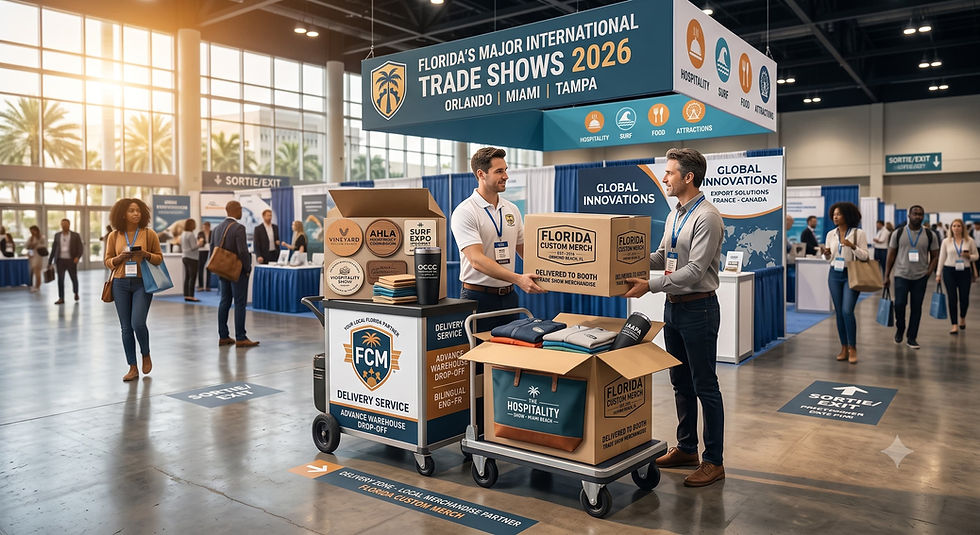
How Many Trade Show Giveaways Should You Order? A Better Way to Set the Quantity

Your trade show expects 2,000 attendees.
So should you order 2,000 giveaways?
Probably not.
But ordering 300 because “not everybody will stop at the booth” is not much of a strategy either.
The right giveaway quantity depends on who you actually want to reach, how the merchandise will be distributed, how much booth traffic you reasonably expect, whether certain people are supposed to receive something better, and what happens to anything left over. Event attendance is useful information, but it is only one number in the decision.
Not sure how many promotional products to order for an upcoming event? Tell Florida Custom Merch the expected attendance, event type, audience, booth or distribution plan, budget, products you are considering, and what happens to leftovers. We can help structure the quantity around the actual event rather than automatically ordering one piece per attendee. Ask Florida Custom Merch About Your Event Merchandise →

Start With the Number of People You Can Realistically Reach
Total event attendance is not the same as the number of people who will interact with your company.
A 10,000-person trade show may generate 600 meaningful booth visitors for one exhibitor and several thousand for another. Booth location, company recognition, speaking sessions, demonstrations, contests, sponsorships, staff activity, and the nature of the audience can all affect traffic.
That means ordering one giveaway for every registered attendee can dramatically overstate what you actually need. The first useful number is not total attendance but the number of people your merchandise can realistically reach.
Ask How the Merchandise Will Be Distributed
Quantity planning becomes much easier once the distribution method is clear.
Are the products sitting openly on a booth table for anyone to take? Will staff hand them out after conversations? Are they inside registration bags? Are they reserved for customers, appointments, speakers, VIPs, or qualified prospects?
Those situations can produce completely different quantities at the same event. A giveaway intended for every registered attendee should be planned differently from a $25 item being reserved for fifty serious prospects.
“One Per Attendee” Makes Sense Only in Certain Programs
There are situations where ordering close to the full attendance count is entirely reasonable.
If every attendee receives a welcome kit at registration, every employee is receiving a launch item, or every participant in a program is entitled to a specific product, the distribution unit is clear. One person equals one product, with an appropriate buffer for late additions or replacements.
That is very different from an exhibitor trying to attract traffic at a large trade show. In that environment, the entire show attendance should rarely become the automatic giveaway quantity.
Booth Giveaways Should Be Based on Booth Traffic
For an exhibitor, the more useful question is how many people are likely to reach the booth.
Previous shows can provide excellent information. If you attended the same conference last year and distributed 550 pieces, that figure is more relevant than the event’s 8,000-person registration count.
If this is your first year, use the information you do have: event size, booth location, number of show hours, team size, appointment schedule, speaking activity, sponsorship exposure, and how aggressively the merchandise will be distributed.
The estimate does not need to be perfect. It simply needs to be grounded in the event rather than copied from the total attendance number.
Decide Whether Everybody Who Stops Gets Something
This question can change the quantity dramatically.
Some exhibitors use inexpensive giveaways to create traffic and are comfortable giving one to nearly everyone who approaches the booth. Others use merchandise only after a meaningful conversation, product demonstration, appointment, scan, or qualification step.
Neither strategy is automatically better. The correct method depends on the objective of the booth and the cost of the product.
But the quantity must match the strategy. If the sales team intends to qualify recipients, purchasing enough merchandise for every passerby may be unnecessary.
Not Every Giveaway Needs the Same Quantity
One of the strongest event-merchandise approaches is to use more than one level of product.
You might have a broadly distributed item for general booth visitors, a better product for qualified prospects, and a premium gift reserved for clients or scheduled meetings. Each tier can have a different quantity because each serves a different audience.
This often creates a better program than buying 1,500 identical products simply because 1,500 people might walk past the booth. Merchandise becomes part of the sales and event strategy rather than one large undifferentiated pile.
Start With Audience Tiers
Before finalizing quantities, separate the people you care about into useful groups.
There may be general attendees, qualified prospects, existing customers, VIPs, speakers, media, sponsors, employees, or scheduled meeting participants. Not every event will have every category, and some groups may overlap.
Once those audiences are visible, the quantity question changes from “How many giveaways?” to “How many products do we need for each purpose?” That is a much easier and more useful decision.
Premium Gifts Should Usually Be Counted Individually
If the product is intended for twenty-five major customers, thirty speakers, fifty franchisees, or forty scheduled meetings, do not estimate from total attendance.
Count the intended recipients directly and add a small amount of flexibility if appropriate. High-value merchandise is usually better managed through a named or controlled distribution list.
This prevents premium items from disappearing early in the event because someone placed the carton on a general giveaway table. The quantity and distribution rules should support one another.
Low-Cost Giveaways Need a Different Calculation
A lower-cost item designed primarily for broad booth traffic can be handled more flexibly.
You may intentionally order more than the number of serious prospects because the product is helping create visibility, conversation, booth activity, or general brand exposure. That is a legitimate marketing use.
The mistake is confusing broad exposure with unlimited distribution. Even inexpensive items consume budget, freight, storage, staff time, and booth space, so quantity should still have a reason behind it.
Event Duration Matters
A three-hour reception and a four-day conference should not automatically use the same quantity logic.
Longer events create more opportunities for repeat traffic, new attendees arriving on different days, and staff gradually consuming inventory. They also require the team to manage how quickly merchandise is released.
If all the products disappear before lunch on day one, the quantity—or the distribution strategy—was probably wrong. The goal is usually to support the entire event rather than create one very busy first hour.
Divide the Quantity Across Event Days
For multi-day events, do not necessarily place the entire inventory on the booth at once.
If you have 800 broad-distribution items for a four-day show, establish an approximate daily allocation and keep reserve inventory separate. Traffic will not be identical every day, so the numbers can be adjusted as you learn more.
This simple control prevents an enthusiastic first-day staff from giving away most of the merchandise before the event reaches its busiest period.
Keep Some Merchandise in Reserve
Reserve inventory can protect the important parts of the program.
You may need merchandise for scheduled customer meetings, executives arriving later, press visits, speakers, sponsors, or unexpected VIPs. If all inventory is available for general distribution, those products may be gone when the people you most wanted to reach finally arrive.
The reserve does not need to be excessive. It simply needs to reflect the recipients who should not depend on whatever happens to remain.
Staff Can Consume More Inventory Than Expected
Do not forget your own team.
Employees may need apparel, water bottles, notebooks, bags, or other products before the event even opens. Additional staff can also join late, and people sometimes request replacement items during a multi-day program.
Separate staff quantity from attendee merchandise when planning the order. Otherwise, the event team may unknowingly consume products that were counted for customers.
Exhibitors Sometimes Give Away More Than They Realize
The person ordering the merchandise may imagine one item per visitor.
On the show floor, five staff members may each be handing products out independently. Someone puts a stack at the edge of the booth. Attendees take one for themselves and another for a colleague.
A quantity that looked generous in the planning meeting can disappear quickly when there is no distribution discipline. The more open the distribution method, the more the quantity needs either additional buffer or tighter control.
Do Not Let the Product Table Make the Decision
A table piled high with giveaways can encourage exactly the behavior the exhibitor did not intend.
Attendees may assume the products are unrestricted, staff may stop qualifying recipients, and people may take multiples because nobody appears to be monitoring the inventory.
If the merchandise is supposed to support conversations, store most of it behind the booth or in cartons and replenish intentionally. Physical presentation influences consumption.
Think About What Happens to Leftovers
Leftovers are not automatically a failure.
Evergreen products with a company logo may be usable at future events, client meetings, employee programs, recruiting activities, local promotions, or the next trade show. That makes modest over-ordering less risky.
Event-specific products carrying a date, city, annual conference name, sponsor list, or temporary campaign message have a much shorter life. Excess inventory may become effectively unusable the moment the event ends.
The reuse potential should directly affect how much buffer you are willing to buy.
Evergreen Artwork Gives You More Flexibility
If event attendance is uncertain, evergreen branding can reduce quantity risk.
A quality notebook with the company logo can travel to another event. A shirt printed with “2026 Miami Leadership Summit — September 14–16” cannot easily become next year’s giveaway.
This does not mean event-specific artwork is wrong. Commemorative merchandise can be meaningful and appropriate.
It simply means a highly specific design should usually make you more conservative about excess quantity.
Sponsor Merchandise May Need Its Own Quantity
A sponsor may have paid for a defined level of visibility or a specific activation.
If that product is supposed to reach every attendee, the quantity should be tied to registration and the sponsorship commitment. If the sponsor owns a VIP reception or one breakout session, the relevant audience may be much smaller.
Do not simply add sponsor merchandise to the same quantity calculation as the general event giveaway. The sponsorship agreement and audience should determine its distribution.
Welcome Bags Are Easier to Count
Welcome bags usually have a clearer quantity because the event knows how many attendees are registered.
Even then, the number may need adjustment for late registrations, speakers, staff, VIP guests, sponsors, replacements, and last-minute additions. Ordering exactly the registration count can leave no flexibility.
A modest buffer can make sense, especially when the contents are evergreen enough to be reused. The event team should also clarify whether every attendee receives one bag or whether couples, teams, rooms, or families share one.
Hotels and Destination Events Need Guest Logic
At a destination event, attendance and room count may not be identical.
Some attendees share rooms. Some guests may be accompanying spouses. VIPs may receive upgraded gifts. Staff and speakers may be staying at the same property without receiving the same package.
If merchandise is being placed in hotel rooms, count the actual distribution unit. A room drop should not automatically be calculated from the attendee count.
Franchise Conferences Need Another Question
At a franchise conference, one attendee may represent several business locations.
If the merchandise is a personal conference gift, one per attendee may be appropriate. If the products are supposed to return to each franchise location for employees or customers, the number of units or locations becomes more relevant.
A multi-unit operator representing eight stores might therefore need one personal gift but eight location kits. Quantity planning starts with understanding what the merchandise is supposed to do after the conference.
Employee Events Are Usually More Predictable
When the company knows exactly how many employees are attending, quantities can be far more precise.
Still, consider no-shows, late additions, remote employees who should also receive the item, new hires beginning before distribution, and replacements. If apparel is involved, total quantity and size distribution create two separate planning decisions.
The more valuable the product, the more useful a named recipient list becomes. Controlled distribution reduces the need for large speculative buffers.
Grand Openings Are Less Predictable
A public grand opening can be difficult to forecast because attendance may depend on weather, advertising, community interest, press coverage, location, and word of mouth.
The business should decide whether the merchandise is intended for every visitor or whether it is an incentive with a limit, such as the first 250 guests. A defined quantity can actually strengthen the promotion because the distribution rule becomes part of the offer.
Unlimited-sounding promises create quantity risk. A specific promotion gives both the customer and the event team clearer expectations.
“While Supplies Last” Is a Strategy—If It Is Intentional
Sometimes the correct quantity is simply a fixed number tied to the available budget.
If the company can justify 500 quality products but not 1,500 weaker ones, distributing the better item while supplies last may be a reasonable choice. The marketing message and staff instructions should reflect that limitation.
The problem occurs when the company intended to serve everyone but accidentally bought too little. Running out is not automatically a failure if scarcity was part of the original plan.
Do Not Sacrifice Quality Just to Reach Every Person
Suppose the budget allows either 2,000 disposable items or 700 products that recipients are much more likely to use.
The right choice depends on the business objective. If maximum broad exposure is essential, the larger quantity may make sense. If the event is intended to create relationships with a narrower group of prospects, the higher-quality option may provide more value.
Quantity and product quality should be decided together. A large attendance number should not automatically force the merchandise into the lowest possible price tier.
Your Budget Can Be Divided by Audience
A single cost-per-person calculation can hide how differently recipients matter to the business.
An exhibitor may reasonably spend a few dollars on a general visitor and considerably more on a scheduled buyer or existing customer. This allows the overall budget to remain controlled while providing stronger merchandise where the commercial value is higher.
Tiering can also help when the budget does not support one premium item for the full audience. Instead of lowering quality for everyone, focus the investment.
Lead Goals Can Inform Quantity
If your sales team expects 200 qualified leads from the show, that number may be more useful than the 5,000-person attendance figure.
A qualifying gift can be planned around the expected number of meaningful interactions, with additional buffer based on how confidently the team can identify those recipients.
This is especially useful when the product is tied to a demo, meeting, survey, appointment, or lead-capture process. The quantity then supports a measurable business activity rather than general traffic.
Scheduled Meetings Give You the Best Data
If thirty clients have booked meetings at the show, you already know a meaningful part of the premium-gift quantity.
Order for those known recipients first, then add whatever additional number is justified for walk-in opportunities, executives, or unexpected meetings.
This avoids buying premium merchandise as if every attendee were equally likely to become a high-value prospect. Known commitments should anchor the quantity wherever possible.
Speaking Sessions Can Change Traffic
An executive speaking at a conference may drive significantly more booth traffic immediately after the session.
If your company has a keynote, panel appearance, product demonstration, or sponsored education session, normal booth-traffic assumptions may underestimate demand during certain periods.
Merchandise planning should account for those programmed moments. The event schedule can sometimes predict traffic better than the overall registration number.
A Better Booth Location Can Change the Number Too
A prominent booth near registration, food service, a main aisle, or a major entrance may see more traffic than a similar company in a quieter corner.
The reverse is also true. Buyers planning their first year at an event should consider the floor plan rather than treating every exhibitor as if they will encounter the same percentage of attendees.
This is not an exact science. It is simply better information than using total attendance alone.
Large Booth Teams Can Distribute Faster
Five active team members can hand out merchandise much faster than one person.
That sounds obvious, but quantity planning often ignores staffing. If each person is conducting conversations and offering merchandise throughout an eight-hour show day, consumption can add up quickly.
The merchandise plan should reflect how the booth will actually operate. A highly staffed activation needs different inventory control from a small informational booth.
Giveaways Used to Drive Traffic Need More Inventory
Some booths deliberately use merchandise as the attraction.
A visible product, game, drawing, challenge, or social-media activity may create a larger number of interactions than the company would receive otherwise. In that case, increased traffic is the objective, not an accidental consequence.
The giveaway quantity should support the activation for the intended duration. Running out halfway through a promoted program can create disappointment and weaken the experience.
Merchandise Given After Qualification Needs Less
If staff offer the product only after a demonstration, meaningful sales conversation, badge scan, or appointment, the quantity can be tied much more closely to the expected number of those interactions.
This can allow a higher-value product without increasing the overall merchandise budget.
It also changes how the item is perceived. Instead of being something anyone can grab, it becomes part of a more deliberate interaction with the brand.
Samples and Retail Products Should Not Be Counted the Same Way
Some companies distribute actual product samples alongside promotional merchandise.
Those two categories may have different objectives, costs, and recipient rules. A consumer sample intended for broad trial might be distributed widely while the branded gift is reserved for qualified conversations.
Combining them into one quantity can obscure what each item is supposed to accomplish. Plan each category separately.
Shipping Cost Can Affect the Quantity Decision
Ordering another 500 pieces does not add only the unit price.
It may add cartons, freight, pallet space, storage, material-handling fees, drayage, hotel receiving fees, or individual fulfillment costs. This is particularly relevant at trade shows where every additional box may have a cost once it enters the venue system.
Quantity should therefore be evaluated using delivered cost rather than product price alone. The cheapest extra pieces can become surprisingly expensive inventory.
Booth Storage Has Limits
Trade-show booths do not always have room for all the merchandise you ordered.
A large order may require advance-warehouse storage, backstage storage, a service desk, hotel-room inventory, or scheduled replenishment. If the booth itself cannot hold the cartons, the team needs a plan before the show begins.
This can affect whether ordering a large buffer is practical. Merchandise that exists but cannot be accessed conveniently during the event is not helping the program.
Replenishment Can Sometimes Reduce Risk
For local or multi-day events, it may occasionally be possible to hold some inventory nearby and replenish rather than placing everything on-site from the beginning.
That provides more control and reduces clutter, although it requires dependable logistics. The extra inventory still has to be close enough and accessible enough to matter.
When the event is far from the supplier or involves trade-show warehouse rules, replenishment may be much harder. Distribution planning needs to reflect the actual location.
Attendance Forecasts Can Be Wrong
Events can overperform or underperform.
A new marketing campaign may increase attendance dramatically. Weather, travel disruption, competing events, or economic conditions can reduce turnout. Registrations themselves may not equal actual arrivals.
That uncertainty is why the correct quantity is rarely a mathematically perfect answer. The buyer is making a business decision about how much shortage risk and leftover risk to accept.
Decide Which Risk Is More Expensive
This is one of the most useful questions in quantity planning.
What happens if you run out?
What happens if you have 200 left?
If running out means disappointing paid sponsors, VIP customers, registered employees, or attendees who were promised a product, shortage risk may be expensive. If leftovers carry a date and become unusable immediately, over-order risk may be equally important.
The right quantity depends partly on which failure creates the larger business consequence.
Premium Merchandise Usually Deserves a Smaller Buffer
A twenty-dollar or fifty-dollar gift does not need the same speculative cushion as an inexpensive broad-distribution giveaway.
When the item has significant unit value, improve the recipient count rather than simply buying a large surplus. Named lists, meeting schedules, registration information, and controlled distribution become more valuable.
An extra twenty premium gifts can represent more unused budget than several hundred inexpensive items. Buffer should reflect financial exposure.
Low-Cost Evergreen Products Can Tolerate More Flexibility
An inexpensive product with an evergreen company logo that can be used at the next event creates much less leftover risk.
That may justify a somewhat larger buffer when attendance is uncertain. The merchandise effectively becomes inventory rather than event waste.
Storage still matters, and the company should avoid turning “we can use it later” into a habit of accumulating cartons nobody actually wants. Reuse should be realistic, not theoretical.
Do Not Automatically Reorder Last Year’s Quantity
Repeating last year’s order is convenient, but the event may have changed.
Attendance may be larger, booth placement may be different, the product may cost more, the distribution strategy may have changed, or your sales team may now be using merchandise differently.
Use last year’s consumption as evidence, not as an automatic purchase order. The value comes from understanding why you used the quantity you did.
Record What You Actually Distributed
After the event, record the starting quantity, remaining quantity, number reserved for other groups, and whether any particular products ran out.
This turns the next event into a much easier planning exercise.
You do not need a complicated analytics platform. A simple record saying “started with 750, returned with 110, reserved 50 for clients, ran out of premium gifts on day two” already gives the next buyer far more information than total attendance alone.
Leftovers Are Not Always Evidence You Ordered Too Much
Suppose you return with 50 pieces from an order of 1,000.
That may be exactly what a sensible buffer looks like. Trying to achieve zero leftovers can create unnecessary shortage risk, especially when the remaining merchandise is reusable.
The objective should be reasonable inventory, not mathematical perfection. A small useful remainder can be cheaper than running out at the wrong moment.
Running Out Is Not Always Evidence You Ordered Too Little
If the merchandise was intentionally limited to the first 500 visitors and all 500 were distributed, the program may have worked perfectly.
Likewise, a premium gift reserved for qualified prospects may be allowed to run out near the end of the event if the company reached more good prospects than expected.
The question is whether running out prevented the program from fulfilling its purpose. Quantity should be evaluated against the strategy, not merely against whether boxes remained.
Watch Out for People Taking Multiples
Open-table giveaways can produce distorted demand because one visitor may take several pieces.
If the item is intended to reach as many people as possible, staff may need to manage distribution or use signage. Otherwise, the first few hundred visitors can consume merchandise intended for a much larger audience.
This is especially common with products people want to take home for children, coworkers, or family members. That may be acceptable, but it should be intentional.
Give Staff Clear Instructions
A merchandise strategy can fail even when the quantity is well planned if the booth team does not know how the products are supposed to be used.
Explain which items are unrestricted, which are for qualified prospects, which are reserved for clients, and what inventory should remain untouched until later in the show.
Clear instructions make the quantity last as intended. They also prevent awkward situations where one employee is carefully qualifying recipients while another is handing the same product to everyone walking by.
Label the Cartons by Purpose
If the program contains several merchandise tiers, do not rely on event staff remembering which carton is which.
Label products clearly: general giveaway, VIP, customer appointments, staff, speakers, day two reserve, or whatever categories fit the event.
This becomes particularly valuable when different employees arrive at different times or when an agency, hotel, venue, or conference staff is helping with distribution.
Kitting Changes the Quantity Math
If products are being combined into attendee kits, every component needs its own quantity plan.
Suppose 500 welcome kits require a notebook, bottle, badge accessory, and snack container. If only 480 bottles arrive, the entire assembly process may need adjustment even though every other component is complete.
Kitting therefore rewards a clearer buffer strategy. The most difficult or least replaceable component may determine how much extra protection the program needs.
Multiple Destinations Add Another Layer
A 1,000-piece order split among ten offices does not necessarily mean 100 pieces per location.
Each destination may have a different staff count, customer base, event attendance, or distribution purpose. The quantity should be allocated from actual need rather than from simple division.
This is where order planning and fulfillment intersect. The supplier should know the final destination breakdown before packing begins.
International Exhibitors Should Be Especially Careful About Leftovers
An international company exhibiting in the United States may not have an easy place to store unused merchandise after the show.
Shipping hundreds of leftover products back overseas can be impractical and expensive. Carrying them home in luggage may be impossible.
That can justify a more conservative event-specific quantity or an evergreen product that can be shipped to another U.S. event, customer, agency, or local partner afterward. The post-event plan matters more when the buyer does not have a permanent local office.
Agencies Should Get Quantity Approval in Writing
Event agencies and planners may be managing merchandise on behalf of another company.
In that situation, document the quantity assumptions and who approved them. If expected attendance changes or the client changes the distribution strategy, the merchandise quantity may need to change too.
Clear approval protects the program from later confusion about why a particular number was ordered. Quantity is a strategic decision, not simply a line item on the supplier quote.
Do Not Wait Until the Quote to Think About Quantity
Product pricing often changes by quantity tier, which means the number itself affects the available options.
A buyer who says “somewhere between 250 and 1,000” may receive very different recommendations depending on where the likely order will land. Minimum quantities can also eliminate certain products entirely.
Even if the final number is not known, provide a realistic range. The supplier can then identify products and pricing structures that still make sense as the estimate becomes more precise.
Ask for Quantity Breaks When They Are Useful
Sometimes increasing an order slightly can lower the unit price enough to make the additional pieces relatively inexpensive.
That does not mean you should automatically buy more. Extra inventory still has freight, storage, and leftover risk.
But if you expect to use the products again and the next pricing tier is close, it is worth understanding the economics. The decision should be based on total value, not simply on the lowest unit price.
The Cheapest Unit Price Can Encourage Over-Ordering
A lower per-piece price feels attractive, especially when the difference between 500 and 1,000 units appears small on a quote.
But paying less per piece while purchasing hundreds of products you never distribute is not a saving.
Evaluate the total order cost and likely use. Unit price matters, but unused merchandise has a very poor return regardless of how cheap each piece was.
What Should You Tell Your Merchandise Supplier?
Start with expected attendance, but do not stop there.
Explain the event type, expected booth or program traffic, audience groups, distribution method, number of event days, quantity used at similar events, staff count, known VIPs or meetings, whether the merchandise is evergreen, and what should happen to leftovers.
Also give the budget and actual in-hands date. Those details allow the supplier to recommend quantity and product together rather than quoting a number with no understanding of how it will be used.
Trying to determine how much event merchandise to order? Send Florida Custom Merch the event attendance, expected booth traffic, recipient groups, distribution plan, budget, deadline, and products you are considering. We can help structure the quantity around how the merchandise will actually be used. Ask Florida Custom Merch About Your Event Merchandise →
The Best Quantity Comes From the Distribution Plan
There is no universal formula saying you should order merchandise for 50%, 70%, or 100% of event attendance.
A registration gift, unrestricted booth giveaway, qualified-lead gift, client gift, employee item, and VIP product all have different quantity logic. The useful number comes from deciding who the merchandise is for and how they will receive it.
Start with the people, define the distribution rules, understand the cost of running out versus having leftovers, and use whatever real event data you already have. That produces a much better order than simply multiplying total attendance by one.
Get Noticed. Be Remembered.