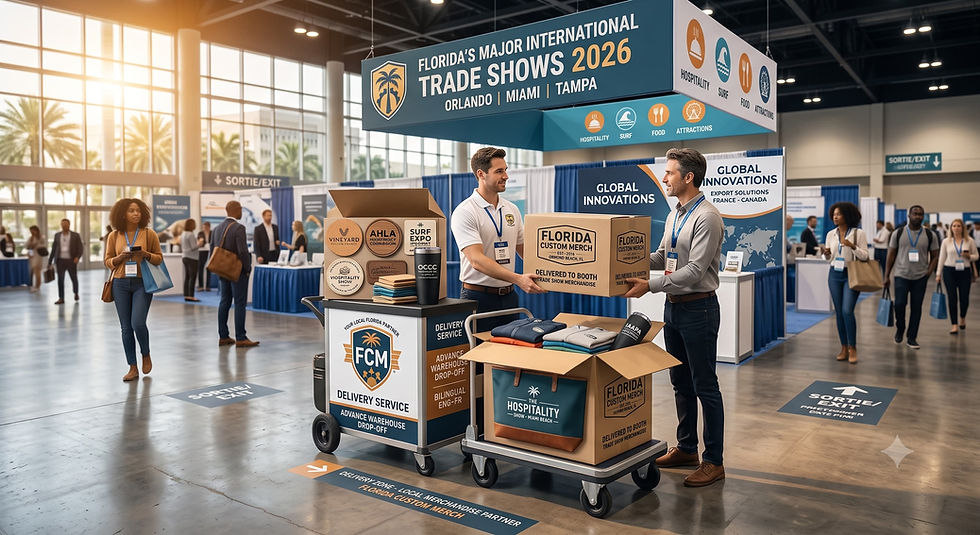
Exhibiting in the U.S. From Overseas? Your Branded Merchandise Should Not Become a Customs Problem

International companies preparing for a U.S. trade show often spend months planning the booth, travel, meetings, sponsorships, and sales strategy. Then branded merchandise gets treated as a relatively simple shipping decision: produce it at home, pack it with the rest of the event materials, and send everything to the United States.
That can work, but it can also create an unnecessary point of failure.
Customs delays, duties, missing paperwork, carrier handoffs, advance warehouse deadlines, hotel receiving rules, and final-mile delivery can turn a straightforward merchandise order into a logistics problem just when the event team has the least time to solve one. In many cases, the safer question is not, “How do we ship our merchandise to the U.S.?” but “Should we produce it in the U.S. instead?”
Exhibiting in the United States and need a local merchandise partner? Tell us the event city, dates, audience, quantity, artwork, budget, and what the merchandise is supposed to accomplish. We can help determine whether U.S.-based sourcing and delivery is the safer route. U.S. Merchandise Support for International Companies →

Start With the Event, Not the Product Catalog
An international exhibitor should not have to become an expert in the U.S. promotional-products market just to prepare for a trade show.
The first conversation should be about the event itself: who is attending, what the company is trying to accomplish, how the branded merchandise will be used, when it must be physically in hand, and where the event is taking place. Once those constraints are clear, the product options can be narrowed to what is actually realistic.
That is especially important when the team is working from another country. A supplier who simply sends hundreds of product links may technically be offering choice, but the buyer still has to figure out which options are available, appropriate, producible, and deliverable.
A local partner should reduce that workload, not add to it.
Shipping From Home Can Add Risk You Do Not Need
Producing branded merchandise in your home country may feel easier because the supplier is familiar, the relationship already exists, and the team may have used the products before.
The problem begins when the shipment enters an international logistics chain.
Customs clearance can take longer than expected. Documentation may be incomplete. Duties or brokerage charges can appear unexpectedly. A shipment may arrive in the United States but still sit in a carrier facility while the event deadline keeps getting closer.
For ordinary inventory, a delay may be inconvenient. For a fixed event, a delay of two days can make the entire shipment effectively useless.
That difference matters.
U.S. Production Can Remove Several Layers of Complexity
Producing the branded merchandise domestically does not automatically make every project easier, but it can remove many of the variables associated with international freight.
The supplier can source within the U.S., decorate domestically, ship within the same country, and coordinate directly with the event destination. That can reduce customs exposure and make replacements or quantity changes easier if something goes wrong.
It also creates more flexibility.
If attendance increases, artwork changes, or a sponsor joins late, a U.S.-based production partner may be able to adapt without restarting an international shipping process.
The value is not simply that the product is made or decorated in the United States. The value is having fewer points where the order can get stuck.
The Real Deadline Is Usually Earlier Than the Show Date
International exhibitors often plan backward from the opening day of the trade show.
That is not always the correct deadline.
The branded merchandise may need to arrive at an advance warehouse several days earlier. It may need to be at the hotel before the team arrives. It may have to be distributed into attendee kits or moved into the booth during setup.
That means the true in-hands date can be significantly earlier than the public event date.
A local supplier should identify that date at the beginning of the project and build the production schedule around it. Waiting until the product is finished to decide where it should go creates unnecessary risk.
Trade-Show Receiving in the U.S. Can Be Confusing
U.S. trade shows often use advance warehouses, direct-to-show delivery windows, general service contractors, material-handling rules, and specific labeling instructions.
For an exhibitor coming from overseas, those systems can be unfamiliar.
A shipment addressed only to the convention center may not automatically reach the booth. A hotel may accept parcels but charge fees or have limited storage. An advance warehouse may stop receiving freight before the branded merchandise is ready.
The supplier should help interpret those logistics rather than leaving the buyer to discover them after production.
That is part of the service.
The Branded Merchandise Should Match the Audience, Not Just the Country
International companies sometimes worry that they need to choose a specifically “American” giveaway.
Usually, that is not the most important question.
The better question is what will make sense to the audience attending the event. A financial-services conference, medical meeting, technology show, construction expo, industrial trade show, and executive meeting may all require very different thinking.
The most effective branded merchandise should connect with the use case, the audience, and the company’s positioning. It might be practical, premium, highly targeted, or something much more specialized, but the category should follow the objective rather than lead it.
If a particular product category becomes part of the solution, the options can then be narrowed based on audience, quantity, budget, production time, brand requirements, and U.S. delivery constraints.
Hard-to-Find Merchandise May Require a Different Sourcing Approach
Some international exhibitors arrive with a very specific idea.
Perhaps the product needs to match an existing European campaign, fit a particular industry, use an unusual material, reflect the shape of the company’s product, or meet a specific brand requirement. Standard catalog options may not be close enough.
That does not mean the project is impossible.
A problem-solving supplier can explore domestic manufacturers, alternative decoration methods, custom packaging, comparable products, or other sourcing routes that preserve the concept. In some cases, the exact requested item may not be realistic within the U.S. timeline, but a strong substitute can still accomplish the same goal.
The important thing is to understand why the original idea matters.
Once that is clear, the sourcing process becomes much more intelligent.
Remote Buying Requires Better Communication
When the buyer and supplier are several time zones apart, vague communication becomes expensive.
The international team should know exactly what is being recommended, what the decoration will look like, what quantity is being produced, when artwork approval is required, when production begins, and where the finished shipment will go.
Proofs should be clear, deadlines should be explicit, and the supplier should be proactive about questions that an overseas buyer may not know to ask.
That is especially true around U.S. event logistics.
Good communication reduces the distance.
Somebody in the U.S. Should Own the Final Mile
This is one of the biggest advantages of having a local partner.
The order should not simply disappear into a carrier network after production.
Someone should be tracking the shipment, confirming the receiving location, understanding who will accept it, and knowing what happens if the venue, hotel, or warehouse creates a problem.
That ownership matters even more when the international team has not yet arrived in the country.
If something goes wrong, the buyer needs a person who can help solve it locally rather than telling them to contact a carrier from another time zone.
A Local Supplier Can Also Help When Plans Change Late
Events change.
Attendance increases, a sponsor is added, a booth activation evolves, the company decides it needs more client gifts, or the original product goes out of stock.
Those changes are difficult enough under a normal timeline.
They become much harder when every adjustment requires another international shipment.
A U.S.-based supplier gives the event team another option. The buyer may be able to supplement the original program locally rather than trying to move additional branded merchandise across borders at the last minute.
That flexibility can be more valuable than the original unit-price difference.
Lowest Unit Price Is Not Always Lowest Total Cost
International buyers naturally compare pricing.
They should.
But the cheapest product price can become expensive once international freight, duties, brokerage fees, expedited shipping, customs risk, warehousing, and replacement exposure are included.
The correct comparison is total landed cost and total event risk.
A domestic U.S. option may have a higher initial unit price while producing a lower overall cost once the full logistics chain is considered.
This becomes especially important when the branded merchandise supports a major trade show investment.
Saving a small amount per unit is not a good trade if the shipment arrives after the event.
Your U.S. Supplier Should Be Comfortable Saying, “That Is Too Risky”
International buyers do not need optimistic promises.
They need accurate ones.
If a product cannot realistically be sourced, decorated, and delivered within the remaining timeline, the supplier should say so and recommend another path.
That may mean changing the product, simplifying the decoration, sourcing domestically, changing the delivery point, or reducing the scope of the program.
The answer should be based on protecting the event, not protecting the original idea at any cost.
You Should Be Able to Ask, “What Would You Do?”
This is one of the simplest tests of a useful supplier relationship.
An international buyer should be able to explain the event, audience, budget, and deadline and then ask, “If this were your event, what would you do?”
The supplier should be able to answer with judgment, not just product links.
That may include advice on whether to produce locally, what kind of branded merchandise fits the audience, what quantities make sense, where the order should be delivered, and which risks are worth avoiding.
That is the difference between buying custom branded merchandise and having a merchandise partner.
Planning a U.S. event from overseas? You do not need to navigate unfamiliar suppliers, production, shipping, and event receiving alone. Tell us the event and what you are trying to accomplish, and we can help build the U.S. side of the branded-merchandise plan. International Companies: U.S. Event Merchandise Support →
The Best International Projects Feel Surprisingly Simple
From the buyer’s side, a U.S. branded-merchandise project can initially look complicated. There is a different country, unfamiliar suppliers, different logistics, a time-zone gap, and an event date that will not move.
A good partner should make that complexity feel smaller.
The buyer explains the event, audience, budget, quantity, brand requirements, and deadline. The supplier helps narrow the merchandise choices, manages the artwork and production process, coordinates delivery, and keeps the buyer informed.
By the time the international team arrives in the United States, the branded merchandise should already be where it is supposed to be.
That is the experience worth aiming for.
Exhibiting in the U.S.? Decide Whether You Really Need to Ship the Merchandise From Home
International shipping is sometimes the right solution.
It should not be the automatic one.
Before producing branded merchandise overseas for a U.S. event, compare that plan with domestic sourcing. Look at production time, customs exposure, total cost, flexibility, receiving requirements, and what happens if something changes late.
The best solution is the one that makes the event easier to execute.
Not the one that simply follows the way the company has always ordered branded merchandise at home.
Get Noticed. Be Remembered.