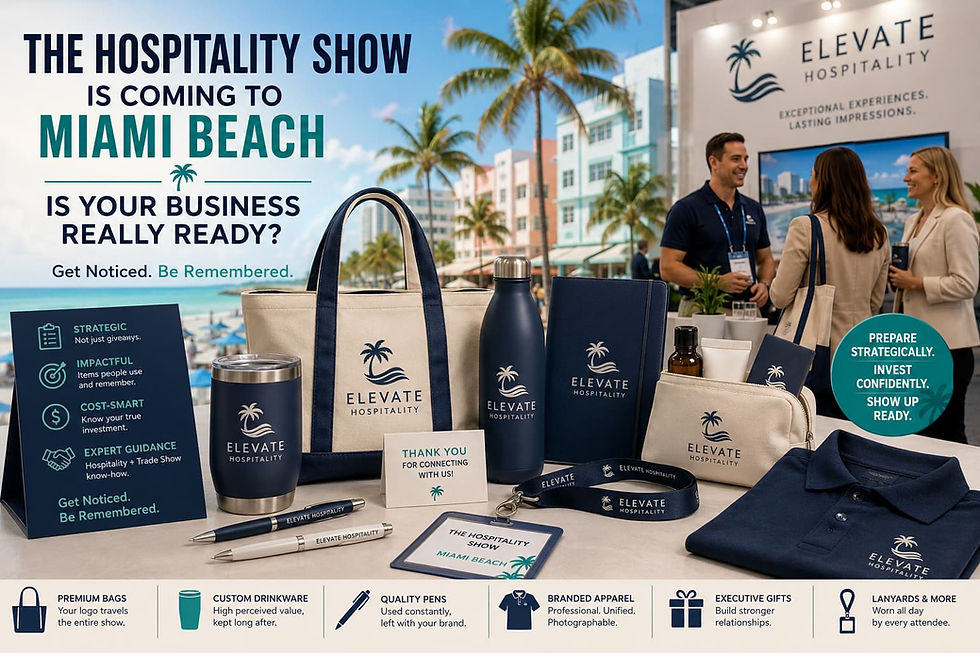
Event Attendance Dropped After You Ordered the Merch. What Should You Do With the Extra?

The merchandise order was based on 1,000 attendees.
Then registrations slowed, several groups canceled, travel plans changed, or the event simply ended up smaller than expected.
Now 650 people may be coming, but 1,000 branded products are already printed, packed, or on the way. The money has already been spent, and the question is no longer how many pieces you should have ordered. The question is what to do with the extra merchandise without turning it into wasted inventory.
The answer depends heavily on what was printed on the products, who else could realistically use them, and whether the merchandise is useful beyond this one event.
Attendance changed after your merchandise was already ordered? Send Florida Custom Merch the product, quantity, event details, artwork, remaining audience, and what has changed. We can help think through whether the extra inventory can be reused, redistributed, repackaged, supplemented, or redirected rather than simply written off. Ask Florida Custom Merch About the Project →

First, Separate “Extra” From “Useless”
Those are not the same thing.
If 300 products are no longer needed at the original event, that does not automatically make them worthless. A notebook, tumbler, bag, charging accessory, polo, or other useful product carrying only the company logo may still have many future uses.
The first step is to identify whether the merchandise is event-specific or evergreen. That one distinction will determine how much flexibility you actually have.
Evergreen Merchandise Is Much Easier to Save
A product carrying the company logo but no event date, city, sponsor list, or temporary campaign message can usually be reused much more easily.
Leftover products may be redirected to another conference, sales meeting, recruiting event, employee program, client visit, grand opening, branch office, or future trade show. The merchandise may have missed its original audience, but it can still perform the same basic branding function somewhere else.
This is one reason evergreen artwork reduces risk. It gives the buyer more options when attendance, schedules, or business plans change.
Event-Specific Merchandise Is Harder
A product printed with “2026 Annual Conference — Orlando” has a much narrower useful life than one carrying only the company identity.
Once the event ends, the item may still be physically useful, but the message dates it immediately. A future recipient may wonder why they are receiving merchandise from an event they never attended.
That does not mean the product has to be discarded. It means the reuse strategy needs to be more deliberate.
Decide Whether the Event-Specific Artwork Still Makes Sense
Not all event-specific branding becomes irrelevant after the event.
Attendees who actually participated may still value the merchandise as a souvenir. Speakers, employees, sponsors, volunteers, clients, or remote participants may also have a legitimate connection to the event even if they were not part of the original distribution plan.
The question is whether the artwork still feels relevant to the new recipient. If it does, the surplus may still have value within the event ecosystem.
Send Merchandise to People Who Could Not Attend
If registered attendees canceled because of travel, illness, scheduling, or other last-minute issues, mailing the merchandise afterward may be an option.
This can be particularly appropriate when the item was part of a paid registration package, VIP experience, employee conference, franchise meeting, or customer program. Instead of treating the no-show as a lost recipient, the organization can extend part of the event experience to them remotely.
The economics still need to make sense. A low-cost giveaway may not justify expensive individual fulfillment, while a premium conference gift often does.
Remote Participants May Be an Overlooked Audience
Events increasingly include people who participate virtually, join selected sessions online, or belong to the organization without attending in person.
If the merchandise supports the broader program rather than only the physical venue, surplus inventory may be used to include those people. This can turn an attendance problem into an engagement opportunity.
The important thing is relevance. Do not mail products simply because they exist; send them where the merchandise reinforces an actual relationship or program.
Employees Can Be a Useful Secondary Audience
Some leftover event merchandise can be redirected internally.
Sales teams, customer-service teams, regional employees, new hires, executives, or employees who supported the event may have a legitimate use for the products. This works especially well when the branding is primarily corporate rather than highly event-specific.
Internal distribution should still feel intentional. A product should not become an employee gift simply because nobody knows what else to do with it.
Sales Teams Often Have Ongoing Use for Good Merchandise
Salespeople regularly meet prospects, customers, referral partners, and accounts outside of trade shows.
Useful leftover merchandise can be placed into the sales organization as client-meeting inventory. That turns excess event stock into a resource rather than allowing it to sit forgotten in storage.
The key is controlling the distribution. Give the team a clear idea of which audiences the product is appropriate for and how much inventory exists.
Customer Follow-Up Can Extend the Event
A company may decide to send a post-event package to important prospects or customers who engaged during the event.
That can be especially effective when the original product was intended to reinforce a conversation, demonstration, launch, or relationship. Instead of distributing the extra merchandise randomly, the buyer uses it as part of follow-up.
This strategy can preserve the original business purpose even though the physical distribution happens later.
Sponsor Merchandise Needs More Care
If a sponsor paid for its logo to appear on the merchandise, repurposing the products outside the original event may create questions.
The sponsor may be perfectly comfortable with broader distribution, particularly if it provides additional exposure. But the event organizer should not automatically assume that the sponsor intended its branding to circulate indefinitely in unrelated contexts.
Review the sponsorship expectation before redirecting large quantities. A quick approval may turn the surplus into additional sponsor value rather than a problem.
Multiple Sponsors Make Reuse Harder
A product containing several sponsor logos can become difficult to use outside the event that connected those organizations.
Future recipients may not understand why unrelated companies appear together on the same merchandise. The product can also create awkwardness if sponsorship relationships change.
This is one reason heavily sponsor-specific merchandise should generally be ordered more conservatively. Once printed, the branding itself limits the future audience.
Apparel Can Often Be Reused More Easily
A shirt, polo, hat, jacket, or other garment carrying the corporate logo may have a long life beyond one event.
Employees can use it later, new hires may receive it, future booth teams can wear it, and sales staff may use it at subsequent events. If the design is attractive and not dated, the surplus can become practical inventory.
Size distribution is the complication. Leftover apparel may not match the sizes needed by the next recipient group, so count the remaining pieces by size before assuming the inventory solves another program.
Count the Actual Surplus
Do not manage the problem from the original purchase order.
After the event, count what remains by product, color, size, version, and condition. Some items may have been distributed, damaged, opened, separated from packaging, or reserved for people who have not yet received them.
The real surplus may be smaller—or less usable—than the headline number suggests. Accurate inventory comes before any reuse plan.
Keep the Inventory Organized
Leftover merchandise loses value quickly when nobody knows what is actually in storage.
Label the cartons clearly with product name, quantity, size breakdown where relevant, event, artwork version, and date. Photographing the product and carton label can also make future planning easier.
Six months later, someone should be able to determine what exists without opening twelve anonymous boxes.
Assign Ownership
Surplus inventory often becomes nobody’s responsibility.
Marketing assumes events has it. Events assumes sales took it. Sales thinks it is at the warehouse. Eventually a new order is placed because nobody realizes 250 usable pieces are already available.
Assign one person or team responsibility for the remaining merchandise. Inventory is much more likely to be reused when someone actually owns the decision.
Put It Into the Next Event Plan Early
If another conference or trade show is already scheduled, determine immediately whether the leftover merchandise fits.
Do not wait until the next event has its own new merchandise order in production. That is how organizations end up buying another 500 pieces while several hundred perfectly usable items remain in storage.
The old inventory does not have to replace the entire new program. It may cover one merchandise tier while the new budget is used for something different.
Leftovers Can Become the General Giveaway
Suppose the original event included a useful, relatively inexpensive product that still carries evergreen branding.
At the next show, that item may become the general booth giveaway while new merchandise is reserved for clients, scheduled meetings, or qualified prospects. This creates a practical merchandise hierarchy without wasting the earlier order.
The surplus is being used strategically rather than merely being “gotten rid of.”
Do Not Force a Bad Product Into a New Program
Reuse is valuable only when the product fits the new audience.
A healthcare conference item may not make sense at a completely different customer event. An event-specific slogan may clash with a new campaign. A product designed for one climate or activity may simply be irrelevant somewhere else.
The money already spent should not force the organization to make another poor marketing decision. Reuse should preserve value, not transfer the original problem to a new audience.
Repackaging Can Sometimes Change the Context
A product may become easier to reuse when paired with new packaging, an insert card, or another piece of current merchandise.
For example, an evergreen item left from a conference could become part of an employee welcome kit or client package. The new presentation gives the product a different context without requiring the original decoration to change.
This works best when the existing branding is neutral enough to fit the new purpose.
Can the Old Decoration Be Changed?
Sometimes buyers ask whether the existing logo or event information can simply be removed, covered, or replaced.
That depends completely on the product and decoration method. Some apparel may accept a patch or another decoration, while engraving, large screen prints, molded branding, or certain imprints may be difficult or uneconomical to alter.
Do not assume redecoration is cheaper than replacement. Have the actual product evaluated before building a recovery plan around it.
A Sticker Is Not Always a Professional Fix
Covering old information with a sticker sounds simple.
Sometimes it can work, particularly on packaging or temporary materials. On the actual merchandise, however, the result may look improvised, may not adhere properly, or may draw more attention to the correction.
Use a cover-up only when it looks intentional. Saving the product is not worthwhile if the solution makes the brand look careless.
Packaging Can Be Easier to Update Than the Product
If the merchandise itself is evergreen but the packaging contains event-specific information, the situation may be much easier.
A card, sleeve, sticker, label, or outer box may be replaceable while the underlying product remains completely usable. This can preserve most of the original investment.
That is another reason to keep temporary messaging off the permanent product when long-term flexibility matters.
Consider a Future Employee Store or Internal Program
Some organizations have enough recurring merchandise use to absorb surplus through internal programs.
Employees may receive products for recognition, incentives, wellness programs, contests, onboarding, sales awards, or team events. Larger companies may also maintain internal merchandise stores.
The product still needs to fit the program. The objective is not to dump unwanted stock internally but to place useful products where the organization already has an ongoing need.
Client Appreciation Can Be Another Outlet
If the product is suitable for customers, leftover inventory may support client appreciation throughout the year.
Account managers can use it for meetings, renewals, thank-you packages, milestones, or relationship-building. A product originally purchased for a conference may remain perfectly relevant to those recipients.
This tends to work best with useful, evergreen merchandise that does not scream “leftover event item.”
Recruiting Can Use Certain Products
Universities, career fairs, candidate visits, internships, and recruiting events create another possible audience.
Again, product fit matters. A notebook, tech accessory, bottle, bag, or appealing apparel item may transfer naturally into recruiting. A highly specialized event product may not.
If recruiting already has a merchandise budget, usable surplus can reduce the need for a separate order while still serving a legitimate purpose.
New Locations and Grand Openings May Absorb Inventory
Companies opening new offices, branches, franchise locations, restaurants, or other sites often need branded merchandise.
Evergreen products can sometimes be allocated to those openings, particularly for employee kits, customer giveaways, or launch events. This may be more efficient than placing a completely new order.
The location team should still know what they are receiving and why. Surplus should be integrated into the launch plan rather than arriving as an unexplained box from headquarters.
Multi-Location Companies Have More Reuse Options
A company with many offices or branches has a larger potential audience for surplus inventory.
One event may have underperformed, but another region could have an upcoming customer meeting, recruiting event, employee program, or local promotion. Central visibility into the inventory makes those transfers possible.
Without that visibility, every location may continue ordering independently while useful products remain unused elsewhere.
Franchise Systems Need Brand Control
A franchisor may be able to redistribute evergreen merchandise to franchisees, field teams, or future openings.
That flexibility is valuable, but the products should still fit the current brand standards and approved program. An old item should not circulate simply because the logo is technically correct.
If franchisees receive surplus inventory, define how it should be used. Controlled redistribution protects both the value of the product and the consistency of the brand.
Donation Is Sometimes an Option
Useful merchandise may sometimes be appropriate for donation, depending on the product, branding, recipient organization, and reason the event inventory is no longer needed.
The company should consider whether it is comfortable having the branded items circulate in that context. Heavily promotional, sponsor-specific, dated, or inappropriate products may not be good donation candidates.
Donation should solve a genuine need for the recipient organization, not simply transfer storage responsibility.
Do Not Create Waste Just to Protect a Perfect Plan
Sometimes teams feel that anything not distributed at the original event has failed.
That is too narrow.
The merchandise was purchased to create value for the organization. If it can create legitimate value through another event, customer relationship, employee program, or future campaign, then the original plan changed but the product still has a job.
The business objective matters more than the original distribution spreadsheet.
But Do Not Store It Forever
The opposite mistake is keeping excess merchandise indefinitely because “we will use it eventually.”
Products age. Packaging becomes damaged. logos change. employee sizes shift. technology becomes dated. storage itself costs money and attention.
Give the inventory a realistic reuse window. If nobody can identify a likely use within that period, the company should make a deliberate disposition decision instead of allowing the cartons to become permanent warehouse furniture.
Record Why the Surplus Happened
Was attendance lower than forecast? Were registrations high but no-shows unusually heavy? Was the distribution strategy more selective than expected? Did the staff simply fail to hand out the merchandise?
Those are different problems.
The next order should respond to the actual cause. Otherwise, the company may reduce the quantity next year when the real issue was poor distribution rather than lower demand.
Registration and Attendance Are Not the Same Number
A conference may have 1,000 registrations and only a portion of those people physically arrive.
That gap is normal enough that event teams should understand their own historical attendance behavior. Some programs have very predictable turnout, while others experience greater variation.
The best future quantity estimate comes from your own data. Track registration, actual attendance, merchandise distribution, and leftover quantity together.
Track How Much Was Actually Distributed
If 700 people attended and only 450 of 1,000 products were distributed, the event did not necessarily have a 550-piece over-order problem.
The distribution method may have limited access, booth staff may have held merchandise back, or recipients may not have wanted the item. Those findings should affect the next product choice and distribution plan.
Count what happened, not merely what remained.
Look at Which Products Were Left
If a multi-product program included a notebook, bag, bottle, and tech item, the surplus may not be evenly distributed.
One product may have disappeared quickly while another remained untouched. That information says something about audience preference and usefulness.
The next program can adjust both the quantity and the product mix. Surplus inventory is market feedback when the organization pays attention to it.
Event-Specific Products Should Usually Have Smaller Buffers
When merchandise becomes obsolete immediately after the event, excess inventory carries more risk.
That does not mean ordering exactly to the registration count. Late additions, damage, VIPs, staff, and uncertainty may still justify extra pieces.
It does mean the buffer deserves more scrutiny. The less reusable the merchandise is, the more expensive over-ordering becomes.
Evergreen Products Can Support a Larger Safety Margin
A useful, timeless product carrying the company identity is easier to reuse.
That flexibility can make a larger buffer reasonable when attendance is uncertain or when running out would create a meaningful problem. The leftover inventory still has a future.
This is one of the most practical arguments for evergreen design. It converts some event uncertainty into reusable corporate inventory.
Consider Two Merchandise Tiers Next Time
If the company wants enough products to cover uncertain traffic without risking a large premium surplus, a two-tier strategy can help.
Use a broader, lower-cost evergreen item for general attendees and a smaller quantity of premium merchandise for known clients, VIPs, or qualified prospects. The expensive inventory is tied to a more predictable recipient group.
That can reduce financial exposure while preserving flexibility.
Order Premium Merchandise Against Known Recipients
The higher the value of the product, the more useful a named or controlled recipient list becomes.
If 75 executives, speakers, franchisees, or clients are supposed to receive a premium gift, count them rather than using total attendance as the basis for the order.
Then add a deliberate buffer rather than a speculative one. This reduces the chance of ending the event with a large quantity of expensive unused merchandise.
Set a Quantity Decision Date
Event registration often remains open longer than merchandise production schedules allow.
Instead of waiting indefinitely, establish the date when the order quantity will be locked. Use the best registration and historical attendance data available at that moment.
This creates a disciplined decision point. The team accepts that the final attendance will still move, but the merchandise cannot wait forever.
A Second Production Run May Be Safer Than One Large Guess
For certain evergreen products and timelines, smaller initial quantities with the possibility of a reorder may reduce excess-inventory risk.
That only works when production time, minimum quantities, pricing, inventory, and delivery allow it. Some products become too expensive or too slow when split into smaller runs.
Ask the supplier whether a staged approach is realistic before relying on it. Flexibility needs to exist operationally, not just conceptually.
Do Not Assume Reorders Will Match Perfectly
If you plan to order more later, remember that a future production run may have changes in inventory, color, decoration, manufacturing, or availability.
For programs where both runs will appear side by side, tell the supplier that consistency matters. Save the product number, artwork, proof, color specifications, and production information.
A staged order can reduce quantity risk, but it creates another type of consistency risk that should be managed.
The Best Recovery May Be No Recovery at All
Sometimes the merchandise is evergreen, attractive, useful, and easy to store.
In that case, the correct answer may simply be to preserve it carefully and use it at the next appropriate opportunity. There is no reason to force an immediate redistribution just because the original event ended with extra pieces.
A calm inventory decision can be better than inventing a weak campaign purely to consume stock.
What Should You Tell Your Merchandise Supplier?
If attendance changes before the order is produced, contact the supplier immediately. Quantity reductions, product changes, or production adjustments may still be possible depending on how far the order has progressed.
If the merchandise is already produced, provide the product, quantity, artwork, remaining inventory, event context, and likely future uses. The supplier may be able to help evaluate redecoration, repackaging, future reorders, or other ways to integrate the surplus into upcoming programs.
The earlier the change is communicated, the more options remain. Once production is complete, the strategy shifts from changing the order to preserving the value of what already exists.
Event attendance changed and now you have more merchandise than you need? Send Florida Custom Merch the product, quantity, artwork, and what is coming up next. We can help think through whether the inventory can be reused, repackaged, redistributed, or incorporated into another merchandise program. Ask Florida Custom Merch About the Extra Inventory →
Extra Merchandise Does Not Have to Become Wasted Merchandise
The worst response to an attendance drop is often to do nothing.
Useful merchandise gets moved into a storage room, ownership becomes unclear, and a few months later another department orders something similar because nobody remembered the inventory existed.
Instead, treat the surplus as an asset that needs a new plan. Count it, organize it, understand how specific the branding is, identify realistic audiences, and assign responsibility for the next use.
You may not recover the original event exactly as planned. But good branded merchandise can often continue doing its job long after the audience count changes.
Get Noticed. Be Remembered.