
Restaurant New-Hire Kits: What to Give Employees Before Their First Shift

Restaurant onboarding moves quickly.
A new employee may interview on Monday, complete paperwork on Wednesday, and be expected to train on the floor by Friday. Managers are coordinating schedules, food-safety requirements, payroll, uniforms, training, POS access, and dozens of other details. In that environment, the physical welcome an employee receives can easily become whatever happens to be available in the office.
That is a missed opportunity.
A thoughtfully planned new-hire kit does not need to be extravagant. Its job is to make the first days easier, communicate that the restaurant is organized, provide the employee with things they genuinely need, and begin building a connection to the brand before the first busy shift is underway.
For restaurant groups and multi-location operators, a standardized onboarding kit can also solve a practical problem: every manager does not have to invent the employee welcome process independently.
Planning employee onboarding merchandise for a restaurant, bar, café, brewery, catering operation, or restaurant group? Florida Custom Merch can help build a practical program around your roles, quantities, branding, budget, and hiring schedule. https://www.flcustommerch.com/restaurants-bars-merch
Start With What the Employee Actually Needs
A restaurant new-hire kit should begin with function, not with a list of promotional products.
What does the employee need before the first shift? What would make training easier? What needs to look consistent in front of guests? What gets lost, forgotten, or improvised when onboarding is handled at the last minute?
For many restaurants, the answer begins with apparel. Front-of-house employees may need branded shirts, polos, aprons, hats, name badges, or outerwear depending on the concept. Back-of-house employees may have different requirements entirely. Outdoor, patio, valet, catering, or food-truck roles may require additional items suited to heat and weather.
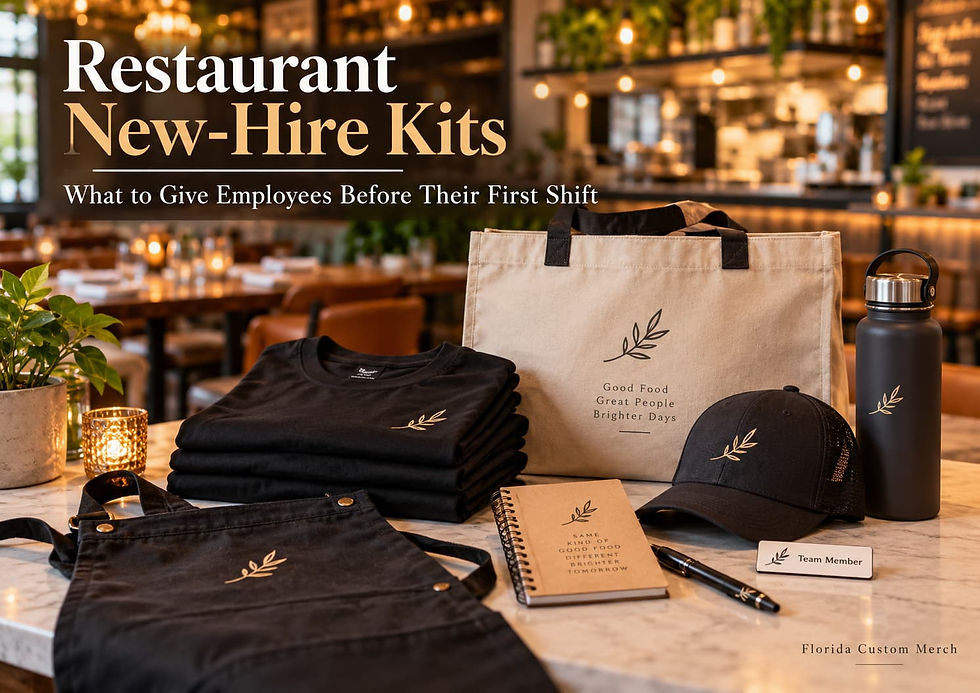
Once those basics are handled, the restaurant can decide whether a few additional items would make the welcome more useful. A durable water bottle, small notebook, pen, tote, insulated lunch item, or another practical product can give the kit more value without turning it into a box full of unnecessary swag.
The objective is not to give employees the largest number of things possible. It is to give them the right things.
The Kit Should Match the Restaurant
A fine-dining restaurant, beach bar, fast-casual concept, brewery, hotel restaurant, coffee shop, and upscale steakhouse should not all have the same employee onboarding kit.
The merchandise should fit the environment.
A casual coastal restaurant might use comfortable branded tees, caps, and an insulated bottle. An upscale concept may rely on understated embroidered apparel, a quality notebook, and packaging with restrained branding. A brewery or entertainment-driven restaurant may have more freedom to make employee merchandise playful or collectible.
That difference matters because the kit communicates something before the new employee has learned every detail of the brand.
If the restaurant tells employees that presentation, hospitality, and attention to detail matter but hands a new hire an uncomfortable shirt in a wrinkled plastic bag, the physical experience contradicts the message.
A well-organized kit says that somebody thought about the employee's arrival.
Separate Required Uniform Pieces From Welcome Merchandise
One of the easiest ways to plan the program is to separate what the employee must have to work from what the restaurant is giving as part of the welcome.
Required apparel may include two or three shirts, an apron, cap, outerwear, or another role-specific garment. These are operational items and should be selected primarily for comfort, durability, laundering, fit, appearance, and the actual work environment.
Welcome merchandise serves a different purpose.
That might be a quality drink bottle, notebook, bag, pin, branded lunch item, or another piece employees can use beyond the shift. The item can reinforce belonging without becoming part of the dress code.
Separating these categories helps the restaurant budget intelligently. A required uniform shirt should not be downgraded just because management wants to add four inexpensive giveaways to the box. Employees will wear that shirt for hundreds of hours. Quality matters much more there than quantity of extras.
Fit and Sizing Are Part of the Employee Experience
Restaurant apparel programs often become more complicated than expected because people are not inventory numbers.
A shirt that technically comes in the correct size can still fit poorly. Men's, women's, unisex, tall, and extended-size options can behave differently. Certain cuts may work well for one role and be uncomfortable for another.
That is why the onboarding program should consider sizing before the restaurant places a large order.
Maintain a sensible size mix for ongoing hiring, but avoid guessing blindly. If hiring volume is substantial, managers can collect sizing before the employee's first day so the kit is prepared properly. For established programs, actual historical usage provides a better guide than a generic size curve.
The goal should be simple: the employee receives apparel that fits, looks professional, and can actually be worn comfortably during a full shift.
Nothing says “welcome to the team” quite as badly as telling a new employee, “We only have an XXL left, but wear it for now.”
Different Roles May Need Different Kits
Consistency does not mean every employee has to receive exactly the same products.
A bartender, server, host, line cook, catering employee, delivery driver, manager, and outdoor service employee work in different environments. Their kits can share the same visual identity while including different functional pieces.
The core program might include common branded apparel and one welcome item for everyone. Role-specific additions can then be layered on where necessary.
For example, a catering employee may need apparel or gear suited to off-site events. An outdoor team may benefit from sun-protective apparel or a cap. Managers may receive a different shirt style or a professional notebook. A restaurant group may even distinguish management trainees from hourly staff while keeping the overall program visually connected.
This is usually better than forcing one item to solve every role.
Think Beyond the First Day
The first kit is only the beginning of an employee merchandise program.
Restaurants have turnover, seasonal hiring, promotions, transfers, new locations, damaged garments, lost items, and employees whose sizes change. A program that works beautifully for the first group of 30 hires but cannot be replenished efficiently becomes a problem very quickly.
Before settling on apparel or merchandise, think about reorderability.
Can the same garment reasonably be sourced again six months from now? Is the artwork stored correctly? Are decoration specifications documented? Does the restaurant know which colors and placements were approved? Who is responsible for ordering replacements?
Restaurant groups and franchises particularly benefit from establishing these standards in advance.
Once the program is documented, a new manager does not have to decide whether the logo belongs three inches wide or four, whether the approved shirt was black or charcoal, or what embroidery thread was used last time.
The brand remains consistent because the decisions have already been made.
Multi-Location Restaurants Need Central Standards and Local Flexibility
A restaurant with one location can manage onboarding fairly informally.
A restaurant group with five, fifteen, or fifty locations cannot.
If every general manager independently buys employee apparel and welcome items, inconsistencies appear quickly. One property uses a different shirt. Another changes logo placement. One manager spends heavily on new employees while another provides only a basic uniform.
A central program can establish the approved core kit, apparel specifications, artwork, budget ranges, and reorder process.
Individual locations can still have flexibility when it makes sense. A Florida beach location may need different outerwear than a northern location. A flagship concept may have different merchandise than a smaller format. Seasonal staffing may justify a simpler kit than management onboarding.
Standardize what should be standard. Allow variation where the actual job requires it.
Don't Fill the Kit With Things Employees Will Throw Away
A welcome kit can become impressive on a spreadsheet very quickly.
Six products sound better than three. Ten products sound better than six.
That does not mean the employee wants ten products.
The better test is whether each item has a plausible use after the box is opened. A comfortable shirt gets worn. A durable bottle may become part of every shift. A useful bag can carry personal items. A decent notebook can support training. Those products earn their place.
A tiny novelty item chosen only because it is inexpensive may contribute almost nothing.
Restaurants should remember that employees experience promotional merchandise differently from event attendees. They see the company every day. They do not need another object simply to remind them of the logo.
The items should either help them work, make them feel more welcomed, or be desirable enough that they genuinely want to keep them.
Presentation Does Not Have to Be Expensive
There is a large difference between thoughtful presentation and expensive packaging.
A kit can be simple and still feel organized.
Fold the apparel correctly. Put items together rather than handing them over individually from different boxes. Include a short welcome card from management. If the restaurant has a strong culture statement, employee promise, history, or set of values, include it in a way a real person might actually read.
A tote or reusable bag can sometimes serve as both packaging and merchandise. In other situations, a clean box or simple branded package may make more sense.
The new employee should feel that the kit was prepared for an arriving team member rather than assembled from whatever happened to be in storage.
That feeling costs very little.
Use the Kit to Reinforce Belonging—Not Just Branding
There is a reason employee merchandise feels different from customer merchandise.
A customer wearing the restaurant's shirt is promoting a place they enjoy. An employee wearing it is representing a place they are part of.
The onboarding kit can begin that sense of belonging.
That does not mean covering everything with motivational slogans. In many cases, restraint is more effective. Good apparel, consistent branding, one or two useful items, and a genuine welcome can communicate more than a box filled with inexpensive products and corporate language.
For long-term employees, restaurants can then build beyond the onboarding kit with service-anniversary gifts, management promotions, employee-of-the-month recognition, seasonal team gifts, opening-team merchandise, or limited pieces available only to staff.
The first-day kit becomes the first stage of a broader employee program rather than an isolated purchase.
Build the Program Before the Next Hiring Rush
Restaurant hiring rarely occurs at a perfectly convenient pace.
A new location opens. Summer season approaches. A manager suddenly needs twelve people. Turnover creates several vacancies at once. An event or catering schedule expands.
That is precisely why the onboarding merchandise should be planned before it becomes urgent.
Choose the core apparel. Establish decoration standards. Decide what belongs in the welcome portion of the kit. Determine how sizing will be collected. Keep enough inventory or reorder lead time to support normal hiring. Document everything so another manager can execute the same program.
Florida Custom Merch works with restaurants, bars, cafés, breweries, catering operations, and F&B groups on employee apparel, onboarding merchandise, opening programs, guest-facing merchandise, and other branded needs. Tell us your roles, hiring volume, quantities, budget, and timing and we can help narrow the program.
A New Employee Is Also Having a First Experience With Your Brand
Restaurants spend enormous effort thinking about the guest's first impression.
The employee has one too.
Their first days tell them whether the operation feels organized, whether details matter, whether managers prepared for their arrival, and whether they are joining a team or simply filling a shift.
A new-hire kit cannot create a good workplace by itself. But when the workplace is already trying to build professionalism, consistency, and belonging, the physical welcome can reinforce all three.
The best restaurant onboarding kits are not the biggest.
They are the ones that make the new employee think: they were expecting me.

