
Need Custom Shirts Before You Know Everyone’s Sizes? How to Build a Better Size Breakdown

You need 250 branded shirts for an event, employee program, conference, opening, or team rollout.
The quantity is easy.
The difficult question is what comes next:
How many smalls? How many mediums? How many larges? How many XLs? What about 2XL, 3XL, women’s sizing, or youth sizes?
If you know exactly who is receiving the apparel, collecting actual sizes is usually the safest solution. But many apparel orders have to be placed before the final attendee list is complete, before every employee responds, or before an open event makes exact sizing possible.
That is when the buyer needs a size strategy rather than a guess.
Need branded apparel but don’t have a final size breakdown yet? Tell Florida Custom Merch the audience, total quantity, apparel style, deadline, whether the recipients are known, and what size information you already have. We can help think through the order before the production deadline forces a blind decision. Ask Florida Custom Merch About Your Apparel Order →
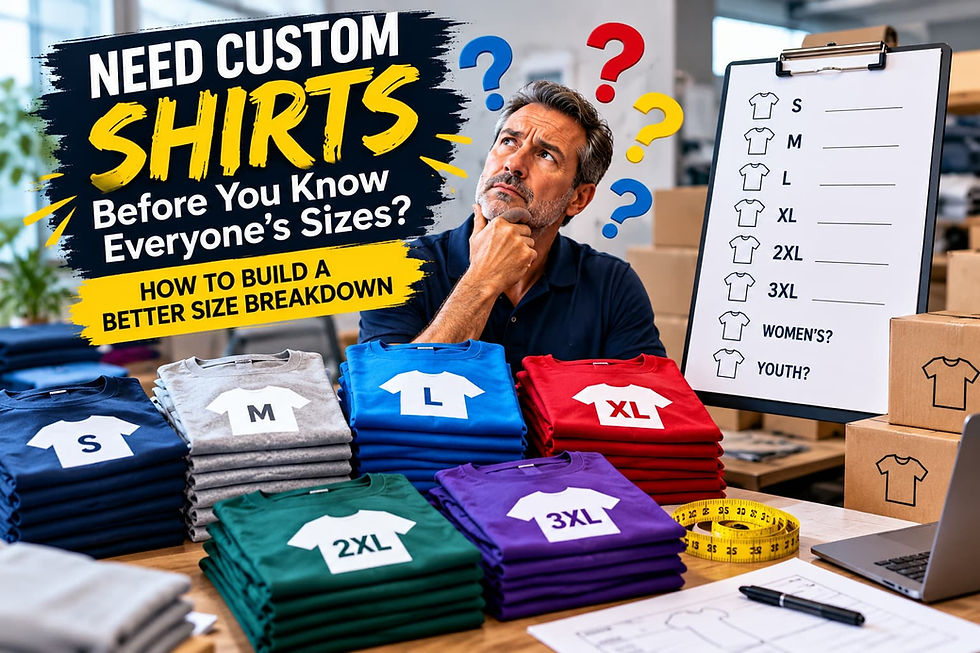
There Is No Universal Shirt-Size Ratio
One of the most common mistakes is searching online for a standard T-shirt size ratio and treating it as if it applies to every group.
A generic ratio can provide a starting reference, but the actual audience matters far more. A group of college students, construction employees, hotel staff, healthcare workers, executives, runners, restaurant employees, or conference attendees may have very different sizing patterns.
The garment itself matters too. Unisex T-shirts, fitted women’s shirts, polos, performance apparel, jackets, and fashion-cut garments do not fit the same way.
That means there is no single percentage breakdown that should be copied automatically into every order.
If You Know the Recipients, Collect Their Sizes
For a defined employee group, volunteer team, speaker list, sales organization, or conference staff, actual size collection is usually more accurate than estimating.
A simple form or spreadsheet can capture each person’s preferred size before the order is placed. This can dramatically reduce both shortages and leftover inventory, particularly when the apparel is relatively expensive.
The tradeoff is time. If dozens of people have not responded and the production deadline is approaching, waiting for perfect information can eventually create a larger problem than estimating a few missing sizes.
Set an internal cutoff date and make the consequences clear: after that date, unanswered sizes may need to be estimated.
Give People the Actual Garment Size Chart
Someone saying “I usually wear a large” is useful, but it is not always enough. Apparel sizing varies by brand, garment style, fabric, cut, and whether the product is unisex, men’s, women’s, or youth.
If possible, give recipients the manufacturer’s size chart for the exact garment being ordered. That allows someone to compare measurements instead of relying entirely on what they wear in another brand.
This becomes especially important for fitted apparel, jackets, polos, and products where the cost per piece is high. The more expensive the garment, the more valuable accurate sizing becomes.
Do Not Assume a Large in One Shirt Equals a Large in Another
Buyers often reorder apparel by remembering only the size label. That can create problems when the garment itself changes.
A large heavyweight unisex T-shirt may fit differently from a large fashion-fit shirt. A performance polo may fit differently from a basic cotton polo, and a women’s cut can differ substantially from a unisex garment even when both carry the same size label.
If the style number changes, treat the sizing decision as new information. Review the specific size chart rather than assuming that the old distribution still applies perfectly.
Start With What You Already Know
Even when the final size list does not exist, there may be useful information available.
Previous employee orders, last year’s event, uniform records, registration data, team rosters, or past apparel distributions may reveal how the audience typically breaks down. That historical information is generally more useful than a generic internet ratio because it comes from the population you are actually serving.
The data does not need to be perfect to help. If last year’s group was similar and you know which sizes disappeared first, that is valuable information for the next order.
Last Year’s Size Mix Is Helpful—but Not Sacred
Historical data is useful only when the audience and garment are reasonably similar.
A conference that attracted 400 people last year may have a very different attendee mix this year. An employer may have added a new department, acquired another company, or changed the type of apparel being distributed.
Use past orders as evidence, not as an automatic reorder template. Ask whether anything important about the people, product, or purpose has changed.
Known Employees and Open Events Require Different Strategies
If 150 named employees are receiving polos, there is little reason to rely entirely on a guessed distribution. You can usually collect their sizes.
An open grand opening, festival, conference booth, community event, or public promotion is different because you may not know who will receive the apparel until distribution begins. In those situations, the goal changes from matching specific people to creating a reasonable range that serves as much of the audience as possible.
The size strategy should therefore begin by identifying whether the recipients are known or unknown. That one distinction affects nearly every decision that follows.
Free Apparel Changes Recipient Behavior
When people are selecting a free shirt at an event, they may not choose the same way they would when purchasing clothing.
Some will size up because they prefer a loose fit. Others may take the closest available size once their first choice is gone. A person may also choose a size for a spouse, child, coworker, or friend rather than for themselves.
That makes open-event distributions less predictable than employee uniform orders. The goal is not perfect size matching; it is reducing the chance that the most requested sizes disappear immediately while less useful sizes remain.
The Audience Demographics Matter
The size distribution for a youth sports event is obviously different from an executive conference, but less obvious audience differences matter too.
Industry, age range, gender mix, geographic market, job type, and event purpose can all influence the likely demand. A workforce involving physical trades may have a different distribution from a university event or office-based professional group.
That does not justify stereotyping individual recipients. It simply means aggregate audience information can help improve a purchasing decision when exact individual sizes are unavailable.
The better the buyer understands the actual audience, the less useful a one-size-fits-all ordering formula becomes.
Unisex Apparel Simplifies the Problem
When sizing information is uncertain, unisex garments can make the order easier to manage because the buyer does not also have to predict the split between separate men’s and women’s cuts.
That does not mean unisex apparel is always the right choice. Some employee programs, premium gifts, uniforms, or brand standards may be better served by more tailored options.
But when the audience is broad and the sizes are unknown, fewer garment variations can reduce complexity. Every additional cut, color, and style creates another inventory decision.
Separate Men’s and Women’s Cuts Multiply the Guessing
Suppose you are ordering 300 polos but do not know the final recipients. If you offer both men’s and women’s cuts, you no longer have one size breakdown to estimate.
You need to estimate how many people will choose each cut and then estimate the size distribution inside each group. That can create significantly more leftover inventory if the assumptions are wrong.
When recipients are known, this is manageable because actual preferences can be collected. When they are unknown, the buyer should decide whether the added choice genuinely improves the program enough to justify the inventory complexity.
Do Not Forget Extended Sizes
2XL, 3XL, 4XL, and other extended sizes are often overlooked until someone needs one. At that point, telling the recipient that the order stopped at XL can create an unnecessarily poor experience.
The correct extended-size quantity depends on the audience and garment. Some products also have price differences or limited availability in larger sizes, which should be identified before the entire order is approved.
Accessibility and inclusion are part of apparel planning. The goal should be to serve the real audience rather than building the size range around convenience alone.
Check Whether Every Size Exists in the Same Color
A shirt may technically be available from XS through 6XL while a particular color is only stocked through 4XL. Another product may have extended sizes but not at the warehouse needed for the project.
That matters because the size strategy can be undermined by inventory reality. If the brand requires one specific garment color, confirm the size range before committing to that style.
Do this before collecting preferences whenever possible. It is frustrating to ask people for sizes the chosen product cannot actually provide.
Inventory Can Change While You Are Collecting Sizes
Even if every required size exists when the product is selected, inventory may move before the final order is placed.
This is particularly important with popular apparel colors, seasonal garments, large orders, and rush timelines. Waiting another week for the last few people to respond may create a new problem if the core sizes start disappearing.
The supplier can help determine how stable the inventory looks and whether waiting is reasonable. Sometimes the deadline for collecting sizes should be driven by stock availability rather than by the calendar alone.
A Small Buffer Can Help
For many employee or event orders, ordering exactly one garment for every known recipient leaves no room for mistakes, late additions, exchanges, damaged pieces, or changes.
A small buffer can provide useful flexibility. The best buffer is generally concentrated in sizes that are most likely to be needed rather than adding the same number to every size automatically.
How large that buffer should be depends on the audience, cost, whether leftovers can be reused, and how difficult the garment is to reorder. There is no universal percentage that fits every program.
Evergreen Apparel Makes Extra Inventory Less Risky
A shirt carrying only the company logo may remain useful for future employees, events, replacements, or giveaways. That makes a modest overage easier to justify.
A shirt reading “2026 Annual Conference — Miami” has a much shorter useful life. Once the event ends, excess inventory may have almost no practical value.
Artwork therefore affects the size strategy. The harder the leftovers are to reuse, the more carefully the buyer should control the quantity.
Date-Specific Apparel Increases the Cost of Guessing Wrong
Event dates, locations, sponsor lists, and temporary campaign messaging can make a garment more relevant during the event but much less reusable afterward.
If the buyer has uncertain attendance and uncertain sizes, combining both uncertainties with highly specific artwork increases leftover risk. A more evergreen design may allow the company to carry extras forward.
This does not mean every event shirt should be generic. It means the buyer should understand that design decisions affect inventory risk as well as aesthetics.
Build Your Buffer Around the Likely Shortage
If your historical orders repeatedly run out of certain sizes first, the next order should respond to that information.
Do not simply add ten extra pieces and spread them evenly from small through 3XL. That may create additional inventory in sizes that were never the problem.
A useful buffer protects against the most likely shortage. Historical use, recipient information, and supplier experience can help identify where that risk sits.
Apparel for Staff Is Different From Apparel for Giveaways
A staff shirt has to fit the actual person wearing it. Giving an employee the nearest available size because the preferred one ran out is not a strong uniform program.
A giveaway shirt has slightly more flexibility because recipients may accept a size up or down, although that should not be used as an excuse for poor planning.
This distinction affects how much effort should go into exact size collection. The more important proper fit is to the product’s function, the less appropriate guessing becomes.
Premium Apparel Makes Mistakes More Expensive
Guessing incorrectly on a low-cost event T-shirt is frustrating. Guessing incorrectly on premium jackets, quarter-zips, embroidered polos, or higher-end outerwear can be substantially more expensive.
For premium apparel, collecting exact sizes or using samples can be worth the extra effort. If the group is known, there is usually little reason to make a large financial decision based entirely on percentages.
The higher the per-piece investment, the more valuable sizing accuracy becomes.
Samples Can Solve More Than Sizing
A sample allows the buyer to evaluate fabric, color, fit, weight, construction, and overall quality before the order is placed. For employee uniforms or premium apparel, it may also help people choose more accurately.
One useful approach is to obtain a size run or representative samples when the program is large enough to justify it. Employees can try on the actual garment rather than translating a chart into a guess.
Sampling requires time, so this should happen early. It becomes much less useful when the production deadline is already only a few days away.
Different Garment Colors Can Fit Differently
Even within the same style, fabric composition or garment treatment can occasionally vary by color depending on the manufacturer. Heathered fabrics, blends, and specialty colors may not always feel exactly like the basic solid version.
Buyers should review the manufacturer specifications when fit is important. This is another reason a product should be evaluated as an exact style and color rather than simply as “a T-shirt.”
For most basic event orders the difference may not materially affect the size plan, but premium programs deserve closer attention.
Jackets Need More Room for Layering
Outerwear creates another sizing issue because recipients may wear clothing underneath it.
Someone who prefers a medium T-shirt may choose a large jacket depending on the style, intended use, climate, and amount of layering. A fitted soft shell behaves differently from a roomy sweatshirt or lightweight windbreaker.
For outerwear, exact recipient preference becomes even more useful. The garment’s purpose matters as much as the label on the size tag.
Employee Uniform Programs Should Keep Size Records
For recurring uniform programs, the organization should not have to rebuild the size list every time.
Maintaining current employee apparel information can simplify replacement orders, new garment rollouts, seasonal pieces, and reorders. Privacy and internal data-handling practices still apply, but from an operational standpoint, accurate size records reduce repetitive work.
The records should not become permanent assumptions. People’s preferences and sizing can change, so employees should have an opportunity to update them when a new program launches.
New Hires Create an Ongoing Size Problem
A company may successfully collect sizes for everyone working today and still need more apparel next month.
If the organization hires regularly, maintaining some blank or decorated inventory in common sizes may make sense. Another option is to schedule recurring smaller orders rather than buying a very large quantity at once.
The right approach depends on hiring volume, minimum quantities, decoration costs, storage, and how quickly the garment can be reproduced. Uniform planning is an ongoing system, not necessarily a one-time order.
Multi-Location Companies Need One Sizing Process
If every branch handles apparel independently, one location may collect exact employee sizes while another simply orders a generic mix. That can create inconsistent employee experiences and uneven leftover inventory.
A multi-location company can standardize the process without necessarily centralizing every order. The core garment, size chart, collection method, buffer rule, and approved size range can all be shared.
That makes apparel easier to manage as the organization grows. It also gives corporate better information about what sizes are actually being consumed across the network.
Franchise Systems Have the Same Challenge
Franchisees may have different staff counts and turnover rates, but the brand still benefits from a consistent apparel program.
The franchisor can define the approved garment and decoration while allowing each operator to order the size quantities needed locally. For network-wide conferences, launches, or staff programs, headquarters may need to combine size data from many locations.
The earlier that collection process begins, the less likely the system is to end up making a large guess at the final deadline.
Conferences Should Separate Staff Apparel From Attendee Apparel
Conference teams often order shirts for employees, volunteers, speakers, and attendees at the same time. Those groups do not necessarily require the same sizing strategy.
Staff and volunteers are generally identifiable and can provide exact sizes. General attendees may be unknown, particularly when shirts are being distributed as an optional giveaway.
Separating those quantities before building the size breakdown produces a much more rational order. Known people should not be forced into the same guessing model as an unknown audience.
Registration Data Can Help
If attendees selected a shirt size during registration, use that information rather than estimating. This sounds obvious, but apparel is sometimes ordered before event registration data is exported or reviewed.
If registration is still open, the current size distribution can still provide useful evidence. The final quantity may increase, but the percentages among existing registrations may help inform the additional pieces.
The buyer should still consider whether late registrants are likely to differ from the early group. Data is useful, but it should be interpreted rather than copied blindly.
Do Not Wait Forever for the Final Registration Number
An event may keep accepting registrations until the day before opening, while custom apparel may need to enter production weeks earlier.
That means the merchandise quantity and size breakdown often have to be locked before the attendee list is final. Waiting until every possible registration arrives can make the product impossible to produce on time.
The correct strategy is to establish a realistic decision date. Use the data available at that point, add whatever buffer the situation justifies, and move the order forward.
Deadlines Can Be More Important Than Perfect Accuracy
An estimated size mix that arrives before the event is more useful than a perfect final spreadsheet created after the production window closes.
This is especially true for custom apparel because decoration, proofing, production, packing, and shipping all occur after the size quantities are chosen. The buyer needs to leave time for those steps.
Good planning balances information quality against the deadline. There is a point where additional certainty is no longer worth losing another production day.
Rush Orders Reduce Your Flexibility
When apparel is ordered under a rush timeline, the buyer may have fewer garment styles, colors, sizes, warehouses, and decoration methods available.
A popular size being out of stock becomes more difficult to work around because there is less time to transfer inventory or wait for replenishment. The size breakdown therefore needs to be coordinated with what is actually available.
A rush order is not simply a normal apparel order performed faster. The available inventory becomes part of the decision.
Confirm Inventory Before the Final Approval
If the order contains several sizes, inventory should be checked across the complete mix.
It does not help to choose a shirt with thousands of units available overall if the order needs 40 XLs and only twelve remain in the required color. The order is only as workable as the sizes you actually need.
For larger programs, this check should happen close enough to approval that the numbers are still meaningful. Apparel inventory can move quickly.
If One Size Is Short, You May Not Need to Change Everything
Suppose the selected polo works in every size except 3XL. That does not automatically mean the entire program must be abandoned.
There may be a companion style, alternate garment, additional color, or another solution that covers the limited shortage. The important question is whether the substitution remains acceptable within the brand and program.
A supplier should help identify the least disruptive solution. Rebuilding a 500-piece order because six garments are unavailable may create more problems than it solves.
Decide What Happens When a Size Runs Out
For public events and giveaways, the distribution team should know the rule before attendees begin choosing shirts.
Can recipients select another size? Are some pieces reserved for speakers or VIPs? Is the apparel first-come, first-served? Will another order be produced afterward?
These questions sound minor until a line forms at the table and only one size remains. A distribution policy protects both the inventory and the staff managing it.
Keep Reserve Apparel Separate
If certain recipients absolutely need shirts, physically reserve those quantities before general distribution begins.
Speakers, employees, sponsors, VIPs, volunteers, or award recipients should not depend on whatever sizes happen to remain after hundreds of attendees pass through registration.
This is partly a sizing issue and partly a distribution issue. The order may contain enough apparel overall and still fail the important recipients if everything is placed into one unrestricted pool.
Do Not Open Every Carton at Once
For large event distributions, keeping part of the inventory organized by size can help staff understand what remains.
If every carton is opened, mixed together, and moved between tables, it becomes difficult to know whether a size is genuinely running low or simply sitting somewhere else in the room.
Clear carton labels and organized replenishment make apparel distribution easier. Good logistics protect the size strategy you worked to create.
Leftovers Are Data
Do not simply put leftover shirts into storage and forget about them.
Record which sizes remained, which disappeared first, and whether attendees were frequently asking for a different size. That information can improve the next event substantially.
A leftover medium is not necessarily a failure. Twenty-five leftover mediums combined with repeated requests for 2XL is a very useful lesson.
Shortages Are Data Too
Running out of a size does not automatically mean the entire order was poorly planned.
The important question is when it ran out and how much unmet demand remained. If two XL shirts were unavailable at the very end of a 1,000-person event, dramatically increasing the XL quantity next year may create unnecessary leftovers.
Capture enough information to understand the scale of the shortage. Future ordering should respond to evidence rather than to the emotional memory of hearing, “We’re out.”
Avoid Building a Size Mix From Anecdotes Alone
Someone on the planning team may insist that “everybody wears large” because large disappeared quickly at the last event.
Perhaps it disappeared because too few were ordered. Perhaps attendees sized up because the garment ran small. Perhaps staff took those shirts first.
Anecdotes can point to a question, but they are weaker than actual distribution records. Whenever possible, convert the experience into numbers before using it for the next order.
Your Supplier Should Ask About the Audience
If the conversation starts and ends with “How many shirts do you want?” important information is missing.
The supplier should understand whether the recipients are employees or unknown attendees, whether the garment is unisex, whether extended sizing is needed, whether historical data exists, and whether leftover apparel can be reused.
Those facts determine how risky the size estimate is. Product sourcing and quantity planning should be connected rather than treated as separate steps.
What Should You Send With an Apparel Quote Request?
Start with the total quantity, audience, garment type, preferred color, artwork, and actual in-hands date. Then provide the size breakdown if you have one, or explain clearly that the sizes are not final.
If the recipients are known, say how many responses are still missing and when you expect them. If the audience is unknown, describe who will receive the shirts and whether they are staff apparel, attendee giveaways, uniforms, gifts, or retail merchandise.
That gives the supplier enough context to help rather than pretending that every group of 300 people should receive the same size mix.
Need to order custom apparel before all the sizes are known? Send Florida Custom Merch the total quantity, audience, garment, deadline, existing size information, and whether leftover pieces can be reused. We can help think through the order before the production window closes. Request Apparel Pricing or Ask About Your Size Breakdown →
The Goal Is Not a Perfect Percentage
There is no magic shirt-size formula that guarantees zero leftovers and zero shortages.
The better approach is to use the best information available: actual recipient sizes when possible, historical data, the specific garment’s size chart, audience characteristics, current inventory, deadline, and how reusable the leftover apparel will be.
Then make a deliberate decision and document what happens during distribution. The next order becomes easier because you are building your own data instead of searching again for a universal ratio that never really existed.
Get Noticed. Be Remembered.

