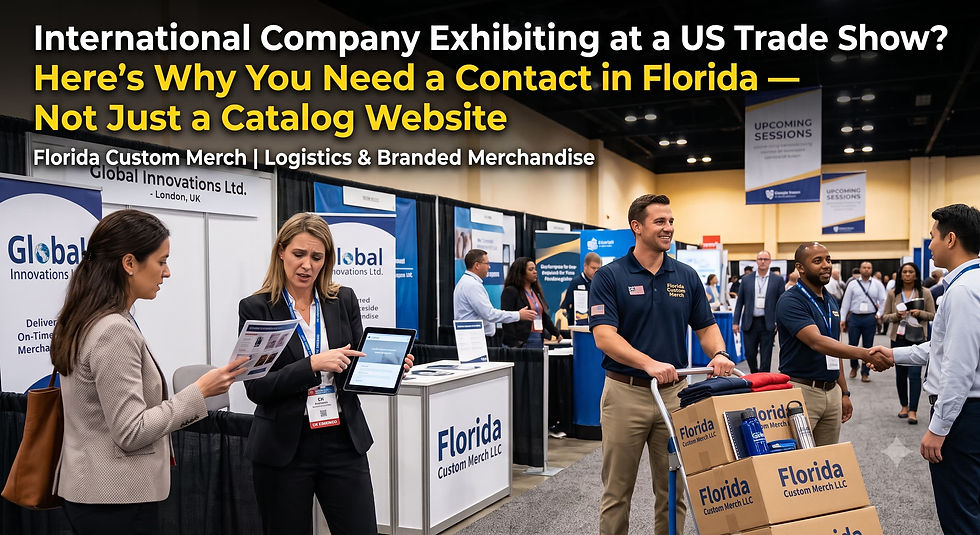
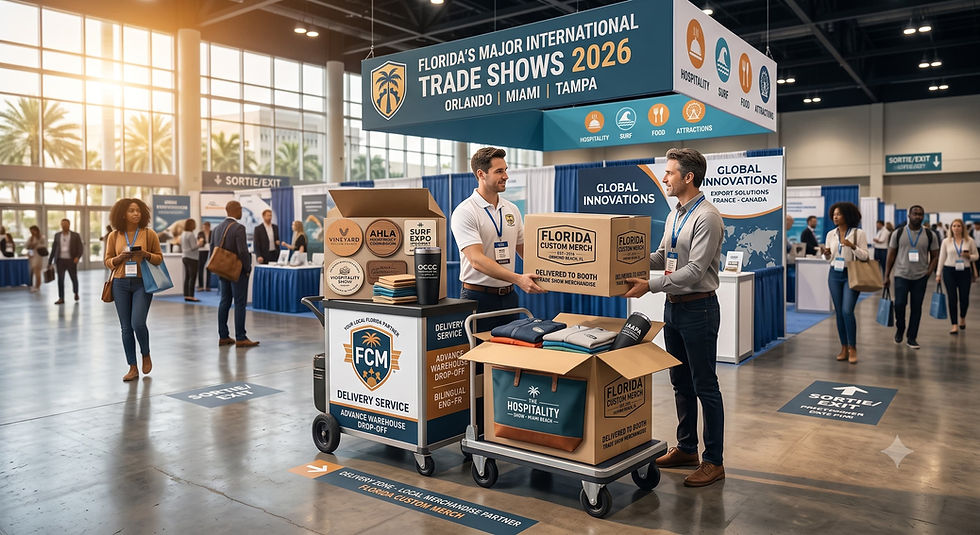
Need a U.S. Branded Merchandise Supplier for Your Trade Show? Here’s What International Companies Should Expect

You have a trade show, conference, corporate event, or customer program coming up in the United States. Your company is based somewhere else, and at some point somebody on the team reaches the same conclusion: we need a supplier in the U.S.
That sounds simple until you begin looking. You may be dealing with suppliers you have never used, product terminology that is slightly different from what you are accustomed to, unfamiliar production timelines, U.S. delivery procedures, time-zone differences, and an event date that cannot move.
At that point, the real question is no longer simply where to buy merchandise. It is how to find a U.S. partner who can understand the brief, make useful recommendations, produce everything correctly, and get it where it needs to be before your team arrives.
International company with a U.S. trade show or event coming up? Florida Custom Merch works with international companies that need branded merchandise sourced, produced, and delivered inside the United States. U.S. Event Merchandise Support for International Companies →

You Should Not Need to Become an Expert in the U.S. Promotional Products Industry
One of the easiest mistakes for an international marketing or event team is spending too much time trying to understand the American supplier landscape. There are thousands of distributors, decorators, manufacturers, online catalogs, and product options, and products that appear identical may have very different inventory positions, production capabilities, decoration methods, and lead times.
You could spend hours researching all of it, but you probably should not have to. If you are responsible for an international event, merchandise is only one part of a much larger project, and the supplier should be able to take a clear brief and turn it into a manageable set of recommendations.
That means you do not necessarily need to arrive knowing the exact product number, manufacturer, decoration method, or U.S. terminology. You should be able to explain what you are trying to accomplish, who will receive the item, what kind of event it is, what impression the brand should make, what quantity is required, what the approximate budget is, and when and where everything needs to arrive.
From there, the U.S. partner should help narrow the field.
If the first response you receive is simply a link to a catalog containing tens of thousands of products, very little work has actually been taken off your plate.
The First Conversation Should Be About the Event, Not the Product
International buyers sometimes begin with a very specific request because that is how the purchasing process worked at home. There is nothing wrong with knowing what you want, but a good U.S. supplier should still ask why.
A bottle for an outdoor Florida event has different considerations from one being placed in a conference room. Apparel for three executives has different requirements from apparel for fifty booth employees. A gift for an important client should not necessarily be selected using the same criteria as something being distributed to every visitor walking past the booth.
Context changes the recommendation.
This is especially important for companies entering the U.S. market because merchandise norms are not identical everywhere. Quantity, presentation, quality level, decoration, and even the way an item is distributed may differ from what your company normally does in Europe, Canada, Latin America, Asia, or elsewhere.
A useful local partner should help you understand those differences without trying to Americanize your brand. Your identity should remain yours; the supplier's job is to help it work effectively in the U.S. environment.
Remote Buying Requires More Communication, Not Less
When the buyer and supplier are several thousand miles apart, good communication becomes part of the product. You cannot casually stop by the supplier’s office to inspect a sample, and your team may not arrive in the United States until shortly before the event.
If something is unclear, a time-zone difference can turn a one-hour question into a full day of delay. That makes clarity important from the beginning.
A supplier working with international companies should be comfortable communicating by email, phone, video, or messaging and should understand that approvals may involve people in several countries. Artwork should be reviewed carefully, product specifications should be clear, delivery dates should be stated as actual required arrival dates, and any substitution should be explained rather than simply made.
This may sound basic, but when the event is immovable and the buyer is across an ocean, basic communication becomes risk management.
You Need an In-Hands Date, Not an Event Date
Suppose your trade show begins on Tuesday. When do you need the merchandise?
Tuesday is almost certainly the wrong answer.
Perhaps the booth team needs it Monday morning. Maybe it is going to an advance warehouse that closes several days earlier. Maybe the hotel needs the cartons before your staff arrives, or perhaps individual kits still need to be assembled before distribution.
The supplier needs the in-hands date: the date by which the merchandise must physically be where it needs to be.
That one detail can completely change what is realistic. An international company contacting a U.S. supplier early enough may have access to a very broad range of options, while the same request made two weeks later may be driven mostly by inventory location, production capacity, and shipping time.
That is why it is better to make contact before every detail has been finalized than to wait until every detail is perfect but the event is only ten days away.
A U.S. Supplier Should Help With the Last Mile
Producing the merchandise is only part of the assignment. It also has to reach the correct destination.
For an international exhibitor, this can be one of the most valuable reasons to work with someone in the United States. A delivery to a convention advance warehouse is different from a delivery to a hotel, and a shipment to a corporate office is different from a shipment directly to an event venue.
Your supplier should therefore be asking about the destination before production begins. Where is the event? Where should the merchandise actually be delivered? Who will receive it? Are there labeling requirements? Is the delivery point a hotel, warehouse, booth contractor, convention center, or another location?
The merchandise is not finished when it leaves the decorator.
It is finished when the right person has it at the right place.
That is especially important when the buyer may not even be in the country until shortly before the event.
You Should Be Able to Ask, “What Would You Do?”
This may be the biggest difference between a vendor and a partner.
Sometimes an international client does not need another quote. They need an opinion.
Perhaps two products are both viable but one carries unnecessary delivery risk. Maybe the item originally chosen is available, but the quality does not fit the audience. Perhaps something commonly used in another market is unlikely to have the same effect in the United States, or maybe the budget would be better concentrated on fewer important recipients rather than spread across everyone.
A useful U.S. partner should be comfortable saying, “If this were my event, this is what I would do.”
That does not mean the supplier makes the decision. It means the buyer gets the benefit of local judgment rather than simply access to local inventory.
For international companies entering an unfamiliar market, that judgment may be worth considerably more than another hundred product choices.
Not sure what merchandise makes sense for your U.S. event? You do not need an exact product before contacting us. Send the event, audience, quantity, approximate budget, destination, and deadline, and we can help narrow the choices. Get U.S. Event Help & Pricing →
Price Matters, But It Should Not Be the Only Qualification
International purchasing departments understandably want pricing. But a quote that is slightly cheaper has very little value if the supplier does not understand the delivery environment, cannot respond when something changes, or does not communicate clearly across the project.
For a time-sensitive U.S. event, reliability has economic value.
Your company may already have invested heavily in exhibit space, travel, hotels, booth design, staff time, sponsorships, and customer meetings. Merchandise is supporting that much larger investment.
Saving a small amount on the merchandise while increasing the risk of a missed deadline is usually a poor trade.
The right question is not simply, “Who has the lowest unit price?”
It is, “Who gives us the greatest confidence that the project will be right and where we need it when we arrive?”
That is a better definition of value.
What Happens If Your Event Is Already Close?
If the event is already approaching, contact someone immediately rather than spending several more days browsing American catalogs.
At that stage, the supplier needs the quantity, artwork, delivery city and ZIP code, actual required delivery date, approximate budget, and the degree of flexibility you have. Then the available inventory and production capacity can determine the realistic choices.
Florida Custom Merch has a dedicated Rush Order Request Form → for projects already working against a short deadline.
Rush capability can solve a surprising number of problems, but the earlier the conversation begins, the more choices remain available.
The Best International Supplier Relationship Should Feel Surprisingly Simple
From the international buyer’s side, a U.S. merchandise project can initially look complicated. You may be dealing with a different country, unfamiliar suppliers, different logistics, a time-zone gap, and an event date that cannot move. A good partner should make that complexity feel much smaller by taking responsibility for the parts of the process that are unfamiliar to you.
You explain the event, audience, budget, quantity, and deadline. The supplier helps narrow the merchandise choices, reviews the artwork, manages production, and confirms the delivery plan with you. By the time your team arrives in the United States, the merchandise should already be where it is supposed to be.
That is the experience international companies should expect from a U.S.-based supplier. You should not be handed another enormous catalog or another vendor relationship to manage from thousands of miles away. You should have a reliable person on the ground who understands what you are trying to accomplish and helps carry the project through to delivery.
If your company is planning a U.S. trade show, conference, corporate meeting, or event, you do not need to solve the American supplier market yourself.
Get Noticed. Be Remembered.