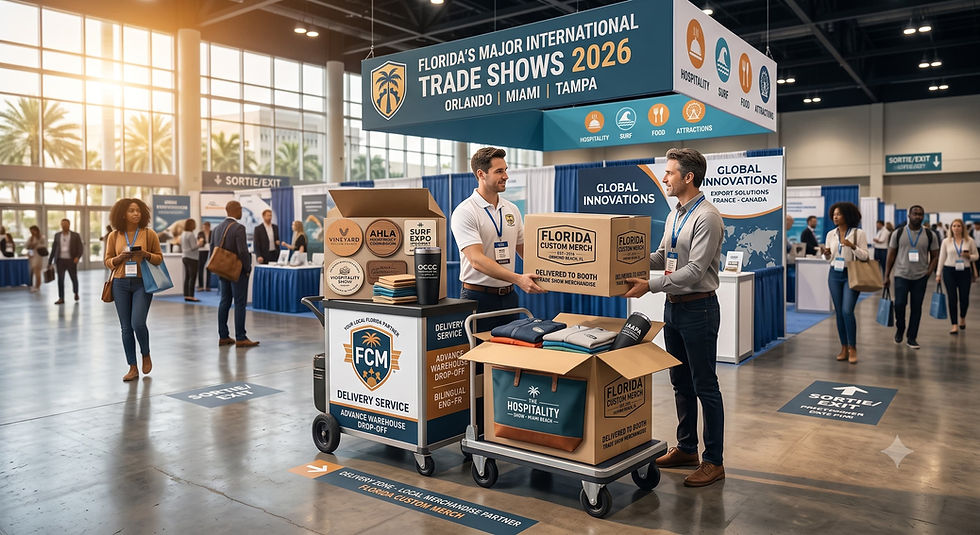
Missed the Trade Show Advance Warehouse Deadline? Here’s What to Do Next

Your trade show is still several days away, the branded merchandise is almost ready, and then someone notices the shipping instructions: the advance warehouse stopped accepting shipments yesterday. That does not automatically mean the merchandise is useless or the order has failed, but it does mean the logistics plan has changed. The next decision now has to be based on the receiving options that are still available, not on the original shipping plan.
Trade-show merchandise has two separate deadlines: when the product must be finished and when someone associated with the event can still receive it. Missing the second can be just as serious as missing the first. Once the advance warehouse closes, the job becomes a logistics rescue rather than a normal shipment.
Missed the advance warehouse cutoff and still need your merchandise at the show? Send Florida Custom Merch the event name, city, show dates, merchandise status, quantity, shipping origin, exhibitor information, hotel details if known, and the receiving instructions you were given. We can help evaluate the remaining delivery options before another day is lost. Ask Florida Custom Merch About a Trade-Show Delivery Problem →

The Advance Warehouse Is Not the Trade Show
An advance warehouse is an early receiving point established for the show. It gives exhibitors a place to send freight before the event, and the event’s logistics system then moves those materials toward the exhibit floor according to the show schedule. When that warehouse closes, the event itself has not disappeared; only the original route has.
The merchandise may still be able to move through a later receiving window, a hotel, a local contact, another controlled address, or a different event-specific delivery path. The important thing is to identify the next valid receiving point before anything ships. The new plan should be built around what is still open and workable now.
Do Not Ship Anywhere Until You Know Who Can Receive It
Once the original warehouse deadline is missed, the worst response is to panic and send the boxes to the first address somebody finds online. A convention center is not automatically a normal receiving address, and a hotel is not automatically prepared to accept large cartons. A booth number alone may also be insufficient to route a shipment properly.
Before anything ships, someone needs to answer three questions clearly: Who can receive it? Where exactly should it go? When will that location accept it? If those answers are uncertain, the shipment is not ready to leave. A rush shipment going to the wrong place is usually harder to recover than a shipment held for a few extra hours while the receiving plan is verified.
Start With the Exhibitor Manual
Trade-show shipping instructions are usually more complicated than ordinary business delivery instructions. The exhibitor manual, service kit, event portal, or logistics instructions may contain different procedures for advance warehouse shipments and later direct-to-show shipments. Those procedures can include different addresses, labels, receiving dates, booth information, carrier requirements, and handling rules.
The original warehouse cutoff does not necessarily tell you what happens next. Some shows provide a later official delivery window, while others have very specific move-in procedures. The first recovery step is to determine whether the show provides another sanctioned delivery path before improvising one.
Direct-to-Show Delivery May Still Be Possible
Many shows have a later receiving period closer to move-in, which can create a second path after the advance warehouse closes. However, direct-to-show delivery is not simply the same shipment with a different street address. The receiving window may be narrow, the labels may be different, and the shipment may need to arrive while the event’s official logistics operation is actively receiving exhibitor freight.
If this route is available, the production and transit schedule now needs to be rebuilt around that specific window. A shipment finishing too late to catch it may still be unusable even if the public show opening is days away. The real deadline becomes the direct-to-show receiving cutoff, not the event date printed on the attendee website.
The New Deadline May Be Much Tighter
Missing an advance warehouse deadline often compresses the entire schedule. A shipment that originally had several days of flexibility may now have to arrive during a one- or two-day receiving period, which makes production delays, carrier delays, weather, weekends, and labeling mistakes much more dangerous.
That can change which shipping service makes sense and may even change whether the original product is still the safest choice if production is not complete. Once the warehouse closes, the logistics deadline can force a product decision. A faster, simpler product may sometimes be more valuable than preserving the exact original idea.
Production and Delivery Should Be Recalculated Together
Suppose the merchandise can be finished Friday. That information alone is not enough if the only remaining receiving option requires the shipment to arrive Friday morning. The product may technically be finished before the show, but operationally it is already too late.
The correct calculation has to work backward from the next valid receiving point, not from the public show date. Production, pickup, transit, receiving hours, and final movement to the team should be treated as one connected schedule. Looking at only one of those pieces can create a false sense that the order is still safe.
A Hotel Can Sometimes Be a Better Backup
If the exhibiting team is staying at a nearby hotel, hotel delivery may be an option. This can work especially well for manageable quantities that team members can physically receive, store, and move to the event themselves or through a local delivery service.
But the hotel needs to be contacted first. The team should verify whether the property accepts packages for guests, how early shipments can arrive, where they are held, whether fees apply, what identifying information is required, and whether the quantity or size creates a problem. A hotel can be a good backup, but only when the receiving process has been confirmed.
Do Not Assume the Front Desk Handles Freight
A small parcel and fifteen cartons are not the same thing. A hotel may be perfectly comfortable holding one box for a guest while having completely different procedures for multiple cartons, pallets, oversized packages, or deliveries arriving before check-in.
That is why the word hotel is not enough as a shipping plan. The actual receiving department, storage capacity, and internal package-routing process matter. A clear receiving contact can be worth more than a perfect address because that person can confirm whether the property is genuinely prepared for the shipment.
Put the Right Information on Every Carton
When delivery is urgent, labeling becomes even more important. A package addressed only to the hotel name may be difficult to locate among dozens or hundreds of incoming shipments. The event team should usually include the recipient name, company, event name, arrival or check-in information where appropriate, contact number, and any instructions provided by the receiving location.
Every carton should be identifiable on its own in case boxes become separated. Numbering them “1 of 8,” “2 of 8,” and so on can also make handoffs easier to verify. In a rush situation, clear carton identification can prevent a minor receiving problem from becoming a lost-shipment problem.
A Local Employee or Agency Can Sometimes Be Safer
Companies often overlook their own local network. A regional employee, local sales representative, event agency, exhibit house, marketing partner, or trusted business contact may be able to receive the merchandise at an ordinary commercial address.
That can simplify the carrier side of the problem dramatically and give the shipment a more predictable place to land. The team can then coordinate the final movement from that location to the hotel or event. This only works if the local recipient understands exactly what is arriving, has enough space, and is available when the shipment reaches them.
Temporary Storage Can Buy You Flexibility
A reliable local receiving location can also give the merchandise somewhere safe to sit if it finishes before the team arrives. That may be better than trying to time the shipment to a hotel check-in window or a narrow convention-center receiving period.
The goal is not simply to get the boxes into the destination city. The goal is to place them somewhere controlled where someone can take responsibility for them. That extra layer of control can be especially valuable when the original trade-show logistics path has already failed.
Someone Needs to Own the Final Mile
The carrier’s job usually ends when the shipment is delivered to the address on the label, but your problem may not. If the cartons arrive at a hotel receiving room, agency office, warehouse, or local employee’s location, someone still needs to know how they will reach the exhibit team.
That may require a vehicle, courier, rideshare-sized shipment, hotel bell services, or another arrangement. The final mile should be planned before the merchandise leaves production, not after the tracking page says delivered. A shipment sitting safely five miles from the convention center can still be useless if nobody knows how to move it.
Ten Small Boxes Create a Different Problem Than One Small Box
Quantity changes the answer. One carton of badge reels may be easy for someone to pick up and carry into the event, while twenty cartons of drinkware are not.
Large or heavy shipments may need professional handling, storage, carts, loading access, or an official show logistics path. The size and weight of the shipment should therefore influence the backup receiving strategy from the beginning. Do not choose a delivery point that can receive the merchandise but cannot practically move it afterward.
The Booth Team May Not Have a Vehicle
Event planners sometimes build backup plans around assumptions that seem simple from the office, such as “someone can just pick it up.” That person may have flown into the city, be using hotel transportation, have no rental car, and be scheduled in meetings from morning until evening.
A recovery plan should consider the people who will actually execute it. If moving the shipment requires a vehicle, identify the vehicle and the person before choosing that delivery route. The plan needs to work in the real event environment, not just on paper.
A Local Courier Can Solve the Last-Mile Gap
Sometimes the merchandise can safely arrive at a local receiving point but still needs to be moved to the event team at a specific time. That can make a local courier or controlled delivery service useful.
The important part is coordination. The pickup contact, delivery contact, exact timing, carton count, destination instructions, and any access limitations should all be confirmed before the driver is dispatched. A courier is not a substitute for a receiving plan; it is one part of a complete plan.
Do Not Use the Convention Center’s Public Address Without Instructions
Convention centers are large operating facilities that may host multiple events, contractors, vendors, exhibitors, employees, loading docks, and receiving systems at the same time. A normal street address does not necessarily tell anyone which event, hall, booth, company, or person should receive a shipment.
If the official show instructions do not tell you to use that address in that way, do not assume a carrier can simply deliver there successfully. Event logistics require more routing information than ordinary office delivery. The venue address may identify the building while still being completely inadequate as a shipping instruction.
The Exhibitor Name and Booth Number Matter
Trade-show shipments often need to be tied clearly to the exhibitor. That sounds obvious, but rush situations are exactly when basic information gets left off labels or the wrong template gets reused.
If the show provides official shipping labels, use the correct version for the current receiving route. Do not reuse an old advance-warehouse label for a later destination simply because it already contains the booth number. The destination, receiving window, and routing method may all have changed.
Do Not Let the Merchandise Arrive Before the Receiving Window Opens
Being early is not always good. If the official receiving window begins Thursday and the expedited shipment arrives Wednesday, the location may refuse it, redirect it, or leave the carrier without a valid delivery option.
That creates exactly the type of carrier exception a rush project cannot afford. The production schedule, pickup time, carrier service, and receiving window need to line up. The shipment should arrive when someone is actually ready and authorized to receive it.
Do Not Let It Arrive Too Late Either
The opposite problem is more obvious. A package arriving after the booth team has completed setup may still be useful, but the logistics become much harder once the show is underway.
A shipment arriving after the event opens may force staff to leave the booth, interrupt meetings, or search for a delivery during show hours. The goal should be to recover enough margin that the merchandise arrives before the team needs to use it. “Before the trade show ends” is not a meaningful success standard.
Setup Day Is Often the Real Deadline
If the merchandise has to be unpacked, counted, divided, placed in attendee bags, organized in the booth, or distributed to staff, it needs to arrive before the public event begins. That makes setup day a much more meaningful deadline than the show-opening date.
Some products may need to arrive even earlier if the team has to assemble kits or combine the merchandise with other materials. When the warehouse cutoff is already missed, defining the true internal deadline becomes critical. Every remaining production and shipping decision should support that date.
If the Merchandise Is Still in Production, Reconsider the Product
A missed warehouse deadline can turn a product problem into a logistics problem, but sometimes the product is still part of the issue. If the original item requires several more production days, the remaining delivery route may no longer support it.
At that point, the buyer should ask whether preserving the exact product matters more than preserving the event deadline. Often, the safer answer is to choose a faster item rather than build the entire rescue plan around an unrealistic finish date. Product flexibility can create logistics flexibility.
Domestic Inventory Becomes More Valuable Under Pressure
When time is short, the safest product is often one that is already available domestically and can be decorated quickly. That removes international freight, customs, and long manufacturing schedules from the rescue equation.
The product itself does not have to be remarkable. It needs to fit the audience, look professional, support the brand, and arrive safely. In a logistics rescue, reliability becomes part of product quality.
The Closest Supplier Is Not Always the Fastest Solution
It may seem logical to choose whatever product is produced nearest the event city, but geography is only one part of the timeline. A supplier farther away may have the inventory, production availability, and shipping service needed to meet the deadline more reliably.
The complete path includes inventory, artwork, production, carrier pickup, transit, and receiving availability. A nearby supplier with no production capacity is not automatically safer than a farther supplier that can finish immediately. The entire chain matters more than distance alone.
A Faster Product Can Still Be a Good Product
Rush decisions do not have to mean accepting junk. The available selection becomes narrower, but there may still be quality drinkware, bags, notebooks, tech items, apparel, badge accessories, wellness products, and other useful merchandise with shorter production schedules.
The key is to stop browsing everything that could theoretically be ordered. At this stage, the relevant catalog is the group of products that can realistically be produced and delivered through the remaining logistics window. That is a much smaller and more useful list.
Artwork Should Already Be Ready
A missed warehouse deadline is a poor time to begin searching for logos. The supplier should receive production-ready artwork, color requirements, imprint instructions, sponsor information, and any mandatory brand standards as early as possible.
If the artwork still needs approval from corporate marketing, legal, sponsors, or another department, that approval chain becomes part of the rescue schedule. Fast production cannot compensate for slow internal approval. The buyer should identify one person who can move the artwork forward without creating another bottleneck.
Do Not Add Complexity Just Because You Are Already Rushing
A rescue project often triggers another bad instinct: since the plan is already changing, people start adding things. Another logo, another imprint location, individual names, custom packaging, or separate versions for different departments can all sound reasonable in isolation.
Every additional requirement can add production time and approval risk. Once the warehouse deadline has been missed, simplicity becomes an advantage. Protect the essentials and avoid creating new production steps that are not truly necessary.
Protect the Critical Branding First
If the timeline no longer supports every original detail, prioritize the elements that actually matter. That may be the main company logo, approved brand color, event message, sponsor requirement, or one key decoration location.
Secondary details can sometimes be removed without weakening the product. The attendee will not know that a second imprint location was originally planned. They will know whether the item looks good and arrived in time.
International Exhibitors Should Avoid Another Border Crossing if Possible
For an overseas company already in a U.S. trade-show rescue, sending additional merchandise from the home country can introduce another layer of uncertainty. Customs clearance, international carrier handoffs, documentation, and border timing can consume the little time that remains.
A U.S.-based sourcing route may give the team more control over production and delivery. That is especially valuable once the advance warehouse has already closed. At that point, reducing the number of logistics variables is often more important than preserving the original sourcing plan.
The Hotel Should Not Be the Default Answer for Every International Team
International exhibitors often view the hotel as the obvious fallback because everyone on the team knows the address. That does not make it automatically suitable.
The shipment may arrive before the guests check in, the names on the reservation may differ from the names on the shipment, the receiving department may have limited storage, and the team may have no easy way to move large quantities to the show. The hotel can be a good solution, but it should still be verified like any other receiving point.
Track the Shipment More Aggressively Than a Normal Order
A normal shipment can tolerate a status check once or twice, but a trade-show rescue may require much closer attention. The team should know when production finishes, when the carrier actually receives the shipment, whether the tracking information shows normal movement, and whether the receiving location is prepared.
If a shipment stalls, that problem should be identified while there is still time to react. The tracking number is not the end of project management. In a compressed schedule, monitoring the actual movement becomes part of the logistics plan.
“Label Created” Does Not Mean the Shipment Is Moving
This distinction becomes especially important in rush work. A carrier label may exist before the cartons have actually left production.
The real question is whether the carrier has possession and the package is moving through the network. When the deadline is tight, buyers should monitor actual carrier scans rather than assuming that the presence of a tracking number means the merchandise is safely on the way. The shipment needs movement, not merely documentation.
Have the Receiving Person Watch the Tracking Too
The person at the destination should not be surprised when the shipment arrives. Send them the tracking information, carton count, expected delivery date, sender information, and any identifying details they may need.
If the carrier attempts delivery and someone at the destination says, “We are not expecting this,” the rescue plan can collapse at the last step. Production, carrier, and receiving should all be aligned. That is what turns a shipment into an actual delivery.
Confirm the Shipment After Delivery
A delivered tracking status is encouraging, but it is not the final confirmation. Someone should physically verify that the cartons were received and can actually be located.
Hotels, event properties, agencies, warehouses, and large offices may have several internal receiving areas. The safest message is not “tracking says delivered.” It is “the recipient has the boxes and knows where they are.”
Count the Cartons Before Moving Them Again
Rush shipments often pass through multiple hands, and that increases the chance of one carton being left behind. If ten cartons arrive at the hotel and a courier moves them to another location, both sides should know the count.
Simple carton numbering can help enormously. “1 of 10,” “2 of 10,” and so on gives everyone a fast way to confirm whether the full shipment made each handoff. Small logistics details become much more important when there is no time to replace anything.
Split Shipments Can Sometimes Reduce Risk
If part of the merchandise is finished earlier than the rest, it may be worth considering whether the order should ship in stages. That can get at least some merchandise into the team’s hands sooner.
The decision depends on freight costs, quantities, receiving logistics, and whether partial inventory is useful. A split shipment is not always economical, but in a fixed-event situation, having 400 pieces on time and 100 pieces later may be more useful than having all 500 arrive after the show.
Reserve the Best Merchandise for the Highest-Value Use
If only part of the shipment arrives in time, distribution should become strategic. The event team may choose to reserve those pieces for customers, VIPs, scheduled meetings, speakers, sponsors, or qualified prospects.
That can preserve the highest-value purpose of the original order. A shortage is frustrating, but random distribution can make it worse. Limited merchandise should support the event objective intentionally.
Do Not Carry More Than You Can Actually Move
Another recovery tactic is to ship merchandise to someone traveling to the event and have them bring it in. That can work for small quantities, but it becomes impractical quickly with heavy or bulky products.
Airline baggage limits, transportation from the airport, hotel storage, physical handling, and event access all matter. The “we’ll just bring it ourselves” solution should be evaluated as a real logistics plan, not as an assumption. If nobody can realistically carry the shipment, it is not a viable backup.
The Backup Plan Should Match the Product
Different products create very different delivery options. A few hundred lightweight wristbands or badge reels are much easier to reroute than hundreds of glass bottles, bulky blankets, or large gift boxes.
That should influence the recovery strategy. If the original product creates impossible final-mile logistics, switching products may be smarter than forcing the same item through an unsuitable route. The product and delivery plan should support each other.
Sometimes Local Pickup Is the Safest Answer
If the supplier or decorator is reasonably close to the event city, local pickup may eliminate carrier transit entirely. Someone still needs to be available, have appropriate transportation, and understand the pickup hours.
But removing one carrier leg can reduce risk when every remaining day matters. The feasibility depends on the product and production location, but it is worth asking when the schedule becomes extremely compressed. In some rescue situations, eliminating transit is the cleanest solution available.
Know the Difference Between “Can Ship” and “Will Arrive”
A supplier saying the order can ship Friday is not the same as saying it will be usable Friday. Transit still has to happen, the receiving location still has to be open, and the cartons still have to be transferred to the team.
For trade shows, the meaningful promise is not the ship date. It is the date and place where the merchandise becomes physically available to the exhibitor. That is the point the schedule should be built around.
Do Not Build the Rescue Around Best-Case Timing
A plan that only works if every single step happens at the earliest possible moment is fragile. If production finishes one hour late, the carrier misses pickup, or hotel receiving closes early, there is no margin.
The better recovery plan includes at least some tolerance whenever possible. That may require choosing a simpler product, faster production method, or safer receiving point. The goal is not to prove that a delivery is theoretically possible; the goal is to make it realistically dependable.
Communicate the Entire Situation to the Supplier
Do not simply say, “We need this rushed.” Explain that the advance warehouse deadline has already been missed and provide the event name, city, show dates, booth number, exhibitor name, quantity, merchandise status, artwork status, original warehouse instructions, and any alternative receiving options you are considering.
That context matters because the supplier needs to help solve the logistics problem, not only accelerate production. The product, production schedule, and receiving route should be evaluated together. A supplier working from the whole picture can often see options that are invisible when the request is reduced to a product quote.
If the Show Uses a Service Contractor, Confirm the Remaining Options
The show’s logistics or service team may be able to clarify whether later freight is accepted and under what conditions. This is especially important if merchandise is large, palletized, heavy, or intended to move through official exhibit freight channels.
Do not improvise around an official event receiving system when the shipment actually requires that system. A quick clarification can prevent a failed delivery attempt. The answer should come from the current show instructions, not from what happened at another event last year.
Every Trade Show Can Be Different
One of the biggest mistakes is assuming that because a delivery method worked at one convention center, it will work the same way at another. Different shows at the same venue may even use different contractors, schedules, labels, and receiving instructions.
The event-specific documentation controls the plan. That is why the logistics should be checked for every show. Trade-show delivery is not a universal address book.
The Event Date Is Not the Logistics Plan
This entire problem usually begins because everyone focused on the date the show opens. But the show date is only the visible deadline.
The merchandise may need to be finished days earlier, shipped days earlier, received within a specific window, moved to the event team, and unpacked before setup finishes. Those invisible deadlines are what determine whether the product actually reaches the booth. Once the advance warehouse cutoff has been missed, they become even more important.
Missing the Warehouse Deadline Is a Problem, Not Necessarily a Disaster
There may still be several workable paths. The merchandise may go through direct-to-show receiving, a verified hotel receiving department, a local agency, trusted employee, exhibit partner, temporary storage point, or another controlled destination.
The right option depends on the show, shipment size, remaining time, production status, and the people available locally. The key is to stop treating the original warehouse plan as if it still exists. Build a new route around the options that are actually available now.
Advance warehouse already closed? Send Florida Custom Merch the show name, event city, dates, booth information, merchandise status, quantity, delivery instructions, and where your team is staying or working locally. We can help evaluate the realistic production and delivery paths that remain. Ask About a Trade-Show Logistics Rescue →
The Rescue Is Not Finished Until the Team Has the Merchandise
Printing the product is not success, shipping the product is not success, and even a carrier marking the cartons delivered is not quite success. For a trade-show rescue, the project is successful when the merchandise is physically where the event team needs it, before they need to use it.
That means production, shipping, receiving, and the final mile have to be planned as one connected problem. If the advance warehouse deadline has already been missed, do not spend the next day wishing the original plan had worked. Find the next valid receiving path, build the production and shipping schedule around it, and make sure somebody owns every handoff until the boxes are actually in the team’s possession.
Get Noticed. Be Remembered.